

You can feel your book. First Forge helps you build it.
First Forge is an AI-guided novel development system. Turn an idea, notes, or a messy draft into a real story. We trained AI as a world-class developmental editor — not a ghostwriter — to help you write the book only you can write.
You can feel your book. First Forge helps you build it.
First Forge is an AI-guided novel development system. Turn an idea, notes, or a messy draft into a real story. We trained AI as a world-class developmental editor — not a ghostwriter — to help you write the book only you can write.


Whether you have a spark or a sprawl, you’re in the right place
Maybe you have a spark so small you're afraid to touch it.
Or you have years of pages — scenes you love, breathing characters — and still no book.
Both are the same ache: something alive, with no way to become whole.
The spark can vanish. The sprawl can swallow years.
You have answered the call. Now the book asks, “Can you build what came?”
Whether you have a spark or sprawl, you’re in the right place
Maybe you have a spark so small you're afraid to touch it.
Or you have years of pages — scenes you love, breathing characters — and still no book.
Both are the same ache: something alive, with no way to become whole. The spark can vanish. The sprawl can swallow years.
You have answered the call. Now the book asks, “Can you build what came?”
The Craft Intelligence no one taught you
You do not need to know the whole book yet. You only need to know you cannot leave it unwritten.
What stands between that and a finished novel isn't talent. It's craft intelligence — the whole invisible knowledge of how books work.
Most writers spend decades acquiring it.
First Forge puts it in your hands now.
So the book does not die inside you. It begins.
The Craft Intelligence no one taught you
You do not need to know the whole book yet. You only need to know you cannot leave it unwritten.
What stands between that and a finished novel isn't talent. It's craft intelligence — the whole invisible knowledge of how books work.
Most writers spend decades acquiring it.
First Forge puts it in your hands now.
So the book does not die inside you. It begins.
See your novel begin to take shape
From fragments to form.
See what belongs.
See what the Shift Looks Like
One writer began with only this:
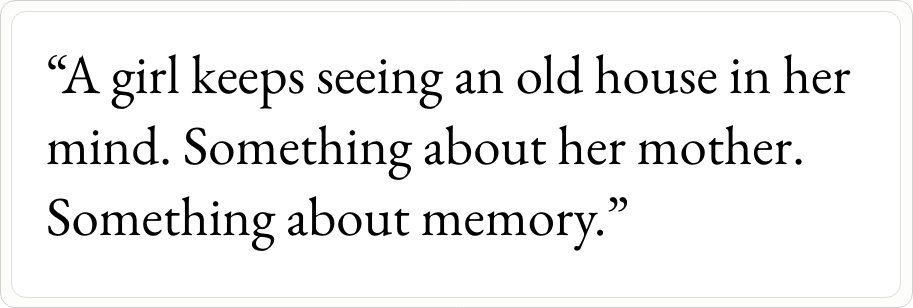
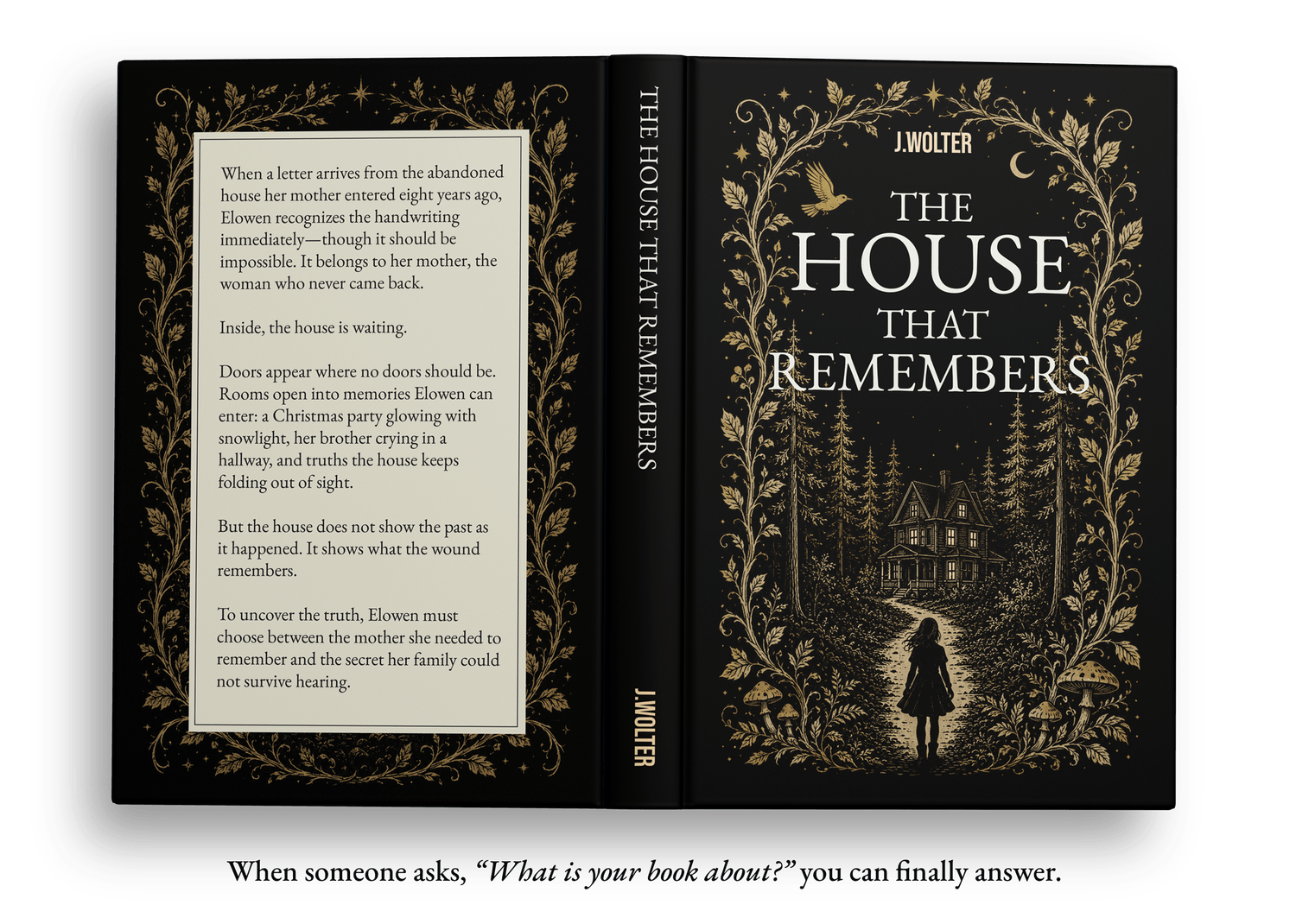
After First Forge, that material begins to reveal a
premise, a promise, and a shape:

See your novel begin to take shape
From fragments to form.
See what belongs.

See what the Shift Looks Like
One writer began with only this:
After First Forge, that material begins to reveal a premise, a promise, and a shape:


What First Forge gives you
Three tools, one unbroken process: find the real book, build the living spine, and refine any part of it for as long as the writing takes.
Core Story Development Tools
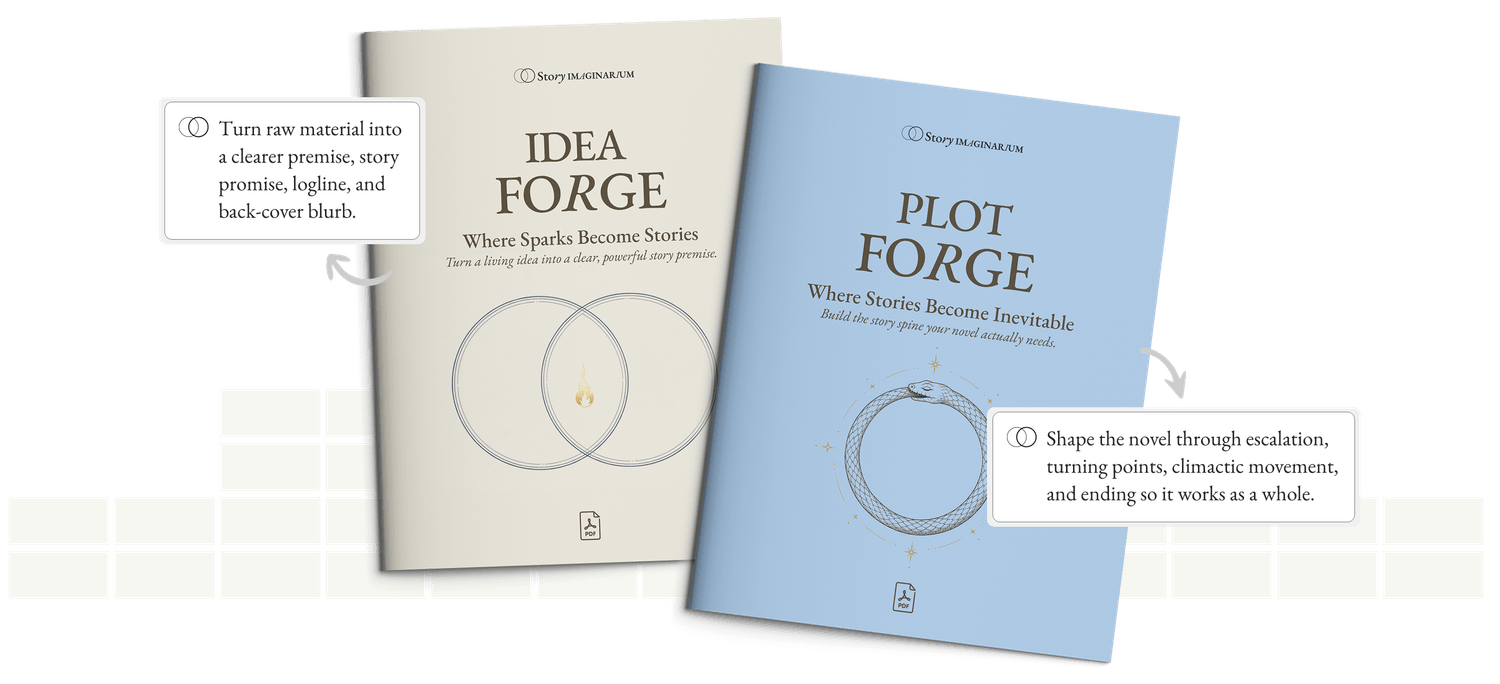
Idea Forge
Find the real book inside the material.
Locate the story’s first living foundation: protagonist, pressure, opposition, stakes, emotional charge, and the promise the book will make. This is where raw material begins to reveal the book it wants to become.
Plot Forge
Build the path the story can travel.
Shape the larger movement of the novel so the story does not remain a collection of beautiful parts. Plot Forge guides causality, escalation, the middle, transformation, and ending direction without forcing the book into formula. This is where the story gathers force, consequence, and movement.
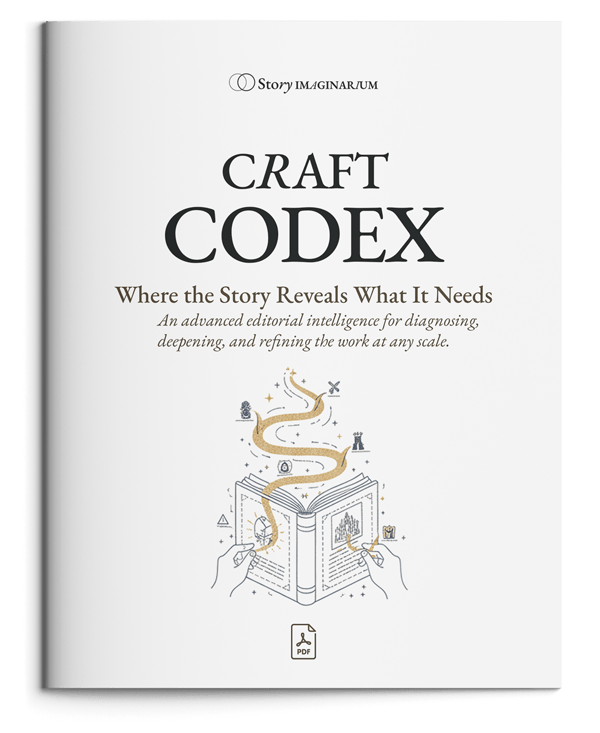
Craft Codex
Reveal what the story is trying to become.
Editorial intelligence for any part of story craft — pacing, character, theme, conflict, voice, world — at any scale, applied directly to your material. Bring it a whole book, a scene, a single line, or just the sense that something isn't yet alive. It reads past the problem you brought to the one beneath it: the strength you're overusing, the thing your story reaches for but never enters, the value swapped for a counterfeit of itself. Then it does what no other tool does — it names the most important thing about your book you didn't ask about, and often didn't know was there. Not ten fixes. One door that makes the whole story unmistakably itself.
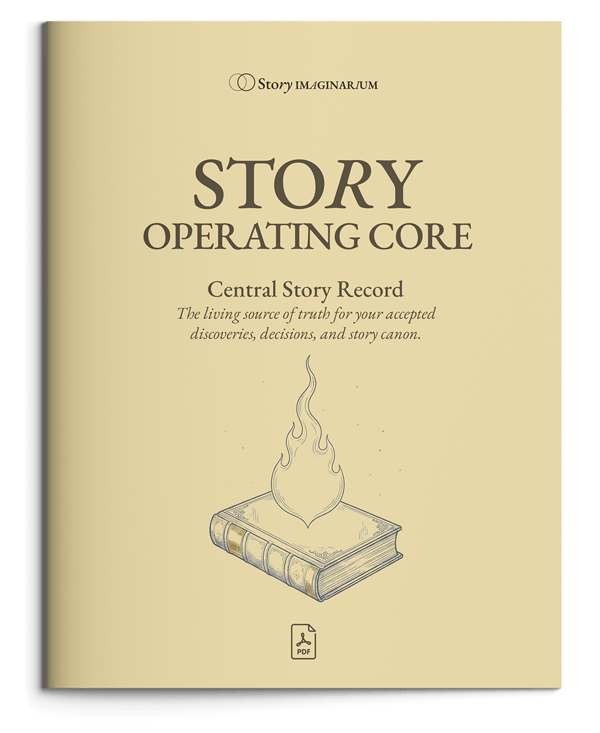
Supporting Materials
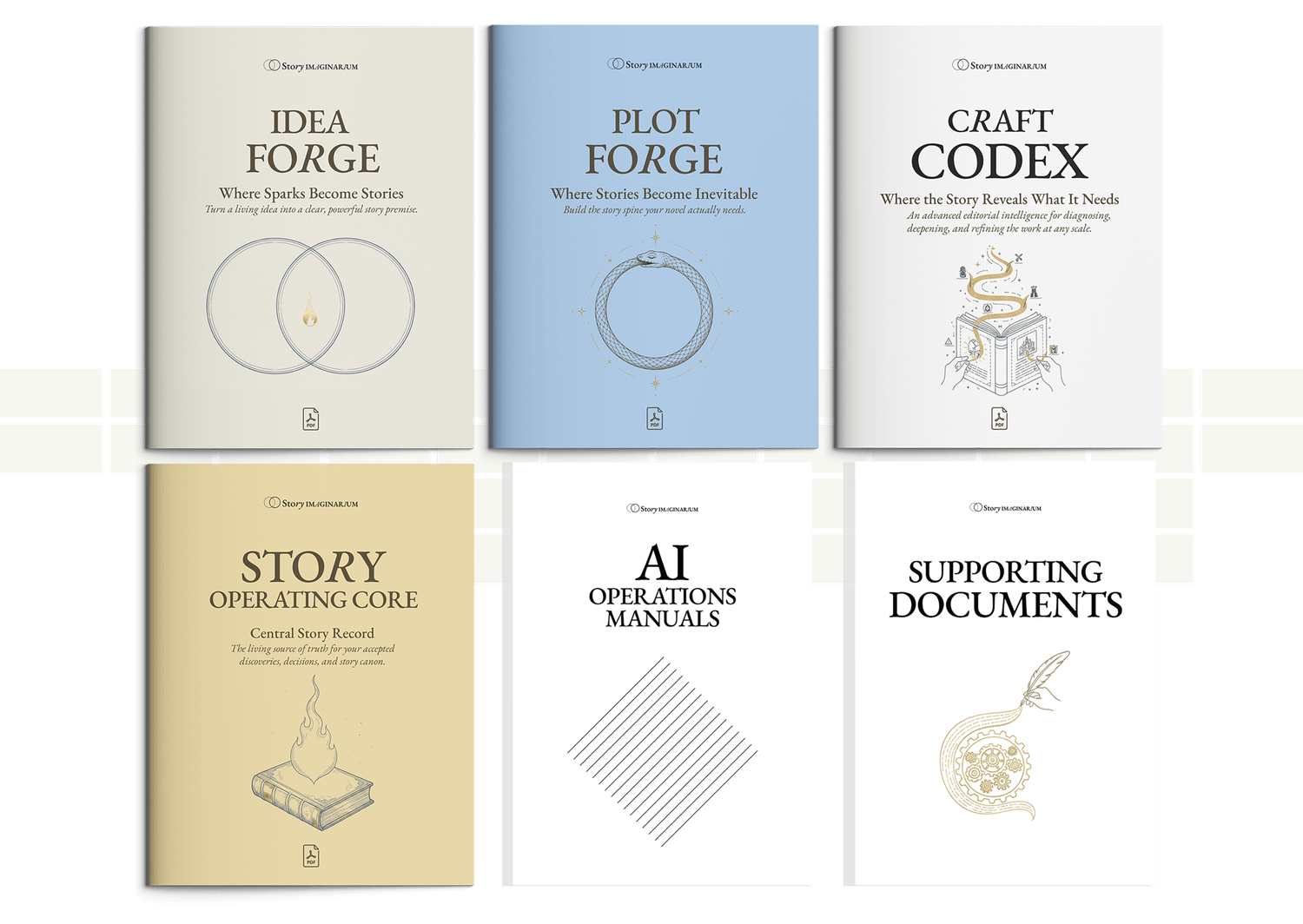
First Forge also includes AI Operations Manuals, orientation tools, story-system supports, and refinement materials to help you move through the process cleanly. A full package breakdown appears below.

Beneath the tools runs one operating intelligence. This is how it sees.
Beneath the tools runs one operating intelligence. This is how it sees.
Every other tool reads your story in one dimension.
First Forge reads it in seven.
Get them into right relationship and you have a book. The Sevenfold Field™ is how — in every forge.
Every other tool reads your story in one dimension.
First Forge reads it in seven.
Get them into right relationship and you have a book. The Sevenfold Field™ is how — in every forge.
First Forge gives the AI a story-shaped mind.
Not more knowledge. A perceptual architecture built to recognize living story.
What loads
An operations manual — the Sevenfold Field™ — loaded into the AI. Seven ways to see, where before there was one.
It stops reading your book as a document and starts hearing what's alive in it: all seven intelligences at once, and everything they're doing to each other. Too much to hold while you're writing.
The portal
You are one circle. The AI is the other. What opens between you is an eye.
For the first time, something can see the whole book at once — as a living field, not a flat document.
For once, the imagination is not asked to fit the tool. The tool is shaped like a story.
The Sevenfold Field™ is built the same way your story is.
That's the whole reason it can read one.
It has a life of its own
Seven intelligences in relation — each deciding what the others are allowed to be.
The house in chapter four wants something you didn't put there. It has been waiting for you to notice. A story is alive. So is the Field. Only a living thing can read a living thing.
Move one thing and everything moves
So the Field moves too.
Add a brother in chapter nine and the book rearranges its bones. The villain shifts. The ending changes. Page three already knew.
And write a magnificent character into the wrong book, and the other six won't have her — the book dies while everyone tells you she's wonderful.
Nothing in a living book gets to be itself alone.
Seven intelligences. Seven worlds.
Not categories. Presences — and they know things you don't.
They are not what you think
Worldbody isn't setting — it's what the ground allows, forbids, and remembers. Kinflow isn't a character sheet — it's the current between beings, what a bond survives and what it becomes when it breaks. Sunshadow is the pressure that exposes. Heartgate is what the story cannot lose. Songvoice is what it will not say. Dreamweave is possibility hardening into consequence. Mysteryfield is what stays veiled — and knows why.
They never stop working on each other
Move one and the rest answer.
Sunshadow decides what Kinflow survives. Heartgate tells Songvoice what it cannot say. You are not moving plot points. You are moving worlds.
The Seven pass your book between them. No one returns it unchanged.
Perceived that way, your story tells you what it needs to become whole.
Everything fitting. That's all a finished book is.
The Field sees:
The missing thing has been leaving tracks. The Field knows how to follow them.
You're trying to fix a sentence. The problem began three chapters ago.
The Field can see both.
The Field is fractal
All seven run through the book, the act, the chapter, the scene, the line.
Zoom in and the same architecture reappears at a new resolution. The Field reads the sentence without losing the chapter — or the word inside it.
The cause is elsewhere
The place where the story hurts is rarely where it broke.
Rewrite the sentence eleven times and it stays wrong because the character never belonged in the scene. Craft intelligence is fractal intelligence — and there are maybe five editors alive who can hold a book this way. Neither of the two taking clients is answering your email.
Zoom in. The story just gets bigger.
What First Forge gives you
Three tools, one unbroken process: find the real book, build the living spine, and refine any part of it for as long as the writing takes.
Core Story Development Tools
Idea Forge
Find the real book inside the material. Locate the story’s first living foundation: protagonist, pressure, opposition, stakes, emotional charge, and the promise the book will make.
Plot Forge
Build the path the story can travel. Plot Forge guides causality, escalation, the middle, transformation, and ending direction without forcing the book into formula.
Craft Codex
Craft Codex is editorial intelligence for any part of story craft — pacing, character, theme — at any scale, directly applied to your material. It diagnoses problems you couldn't see. It reads the layers hiding beneath them. Then it names the one thing you never thought to ask about — and hands you the key.
Supporting Materials
First Forge also includes AI Operations Manuals, orientation tools, story-system supports, and refinement materials to help you move through the process cleanly.

AI can fake the writing. It can’t fake the writer.
Its most seductive trick is giving you the feeling of having written — without the writing having changed you at all. Yours in every way but the one that matters.
First Forge refuses that trade. It reveals the book already alive in your material and teaches you the craft to build it — so you finish not only with a book, but as the writer who wrote it.
The tool can hold the lantern. You still have to walk into the dark.
This matters enough to us that we built an entire training series around it: Sovereign with AI, on using powerful tools without giving yourself away. Its Creative Sovereignty Codex comes with First Forge, free.
You don't leave with borrowed brilliance.
You leave a writer.
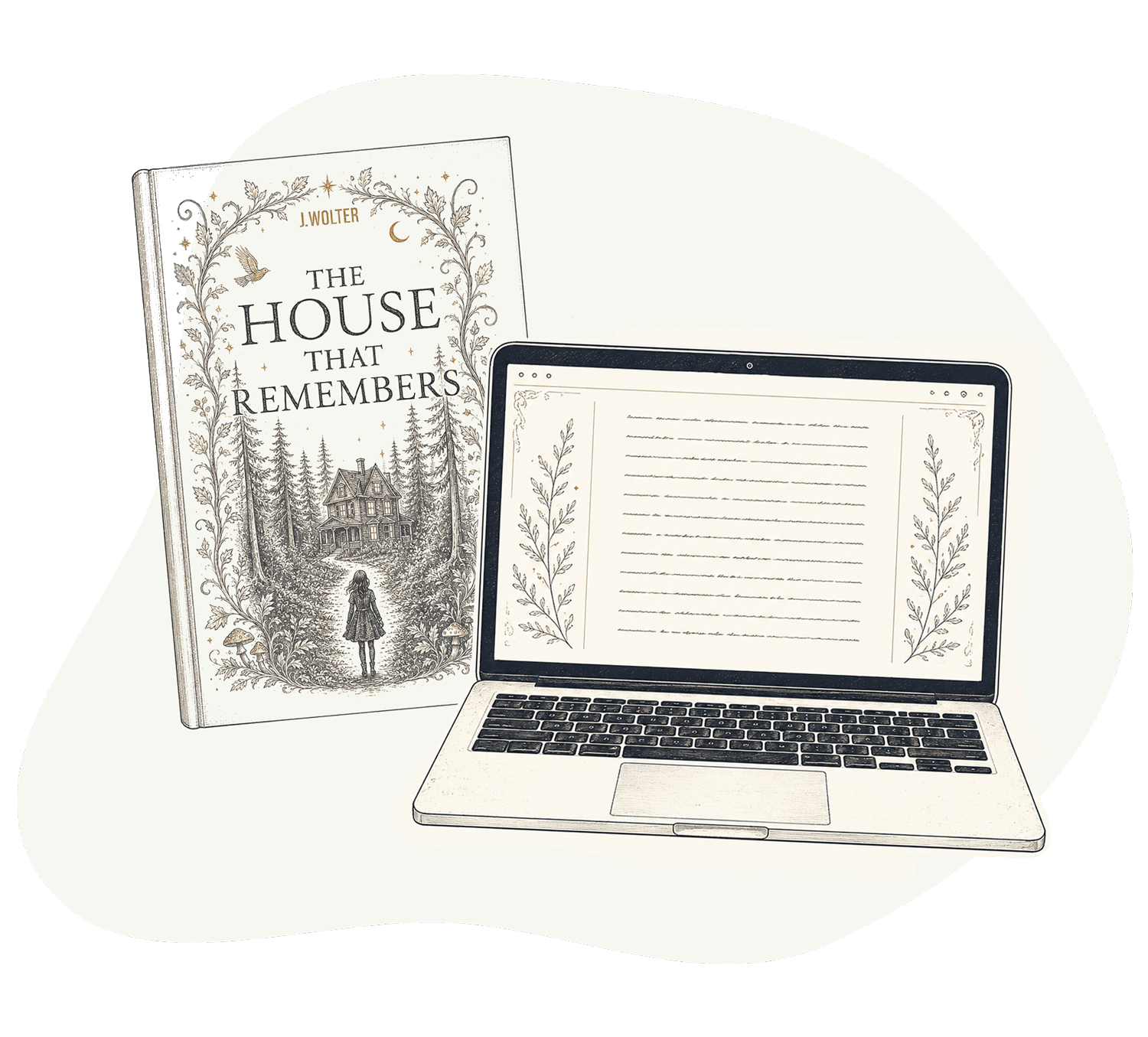
Every writer needs an editor. Not every writer can afford one.
Bring in guidance before the draft gets expensive to fix.
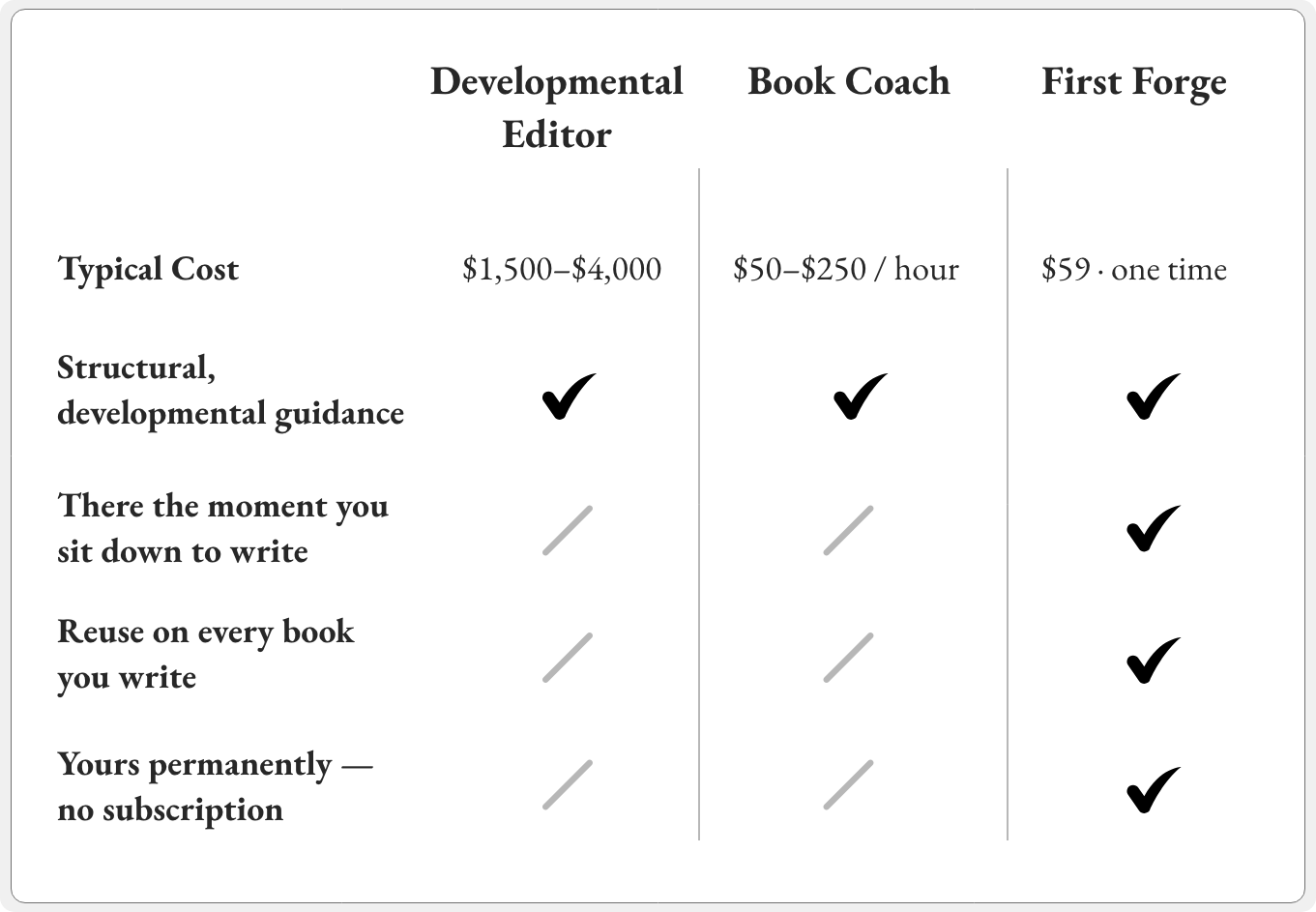
Developmental editing for a novel typically costs between $1,500 and $4,000. Book coaching runs $50 to $250 an hour. Most first-time novelists never get that level of attention — not because they don't need it, but because the numbers don't work.
First Forge brings developmental editorial thinking into the earliest stage of the work: before the draft sprawls, before you've committed years to a version that can't carry the full weight of the novel, before fixing it costs everything.
For $59, you get structural guidance you can return to across the life of the book.
AI can fake the writing. It can’t fake the writer.
Its most seductive trick is giving you the feeling of having written — without the work changing you. Yours in every way but the one that matters.
First Forge refuses that trade. It teaches you the craft intelligence to build your book, so you finish not only with a book, but as its writer.
This matters to us. So we made Sovereign with AI, a training series on using powerful tools without giving yourself away. Its Creative Sovereignty Codex comes free with First Forge.
You don’t leave with borrowed brilliance. You leave a writer.
Every writer needs an editor. Not every writer can afford one.
Bring in guidance before the draft gets expensive to fix.
Developmental editing for a novel typically costs between $1,500 and $4,000. Book coaching runs $50 to $250 an hour. Most first-time novelists never get that level of attention — not because they don't need it, but because the numbers don't work.
First Forge brings developmental editorial thinking into the earliest stage of the work: before the draft sprawls, before you've committed years to a version that can't carry the full weight of the novel, before fixing it costs everything.
For $59, you get structural guidance you can return to across the life of the book.


Everything else is borrowed. This one's yours
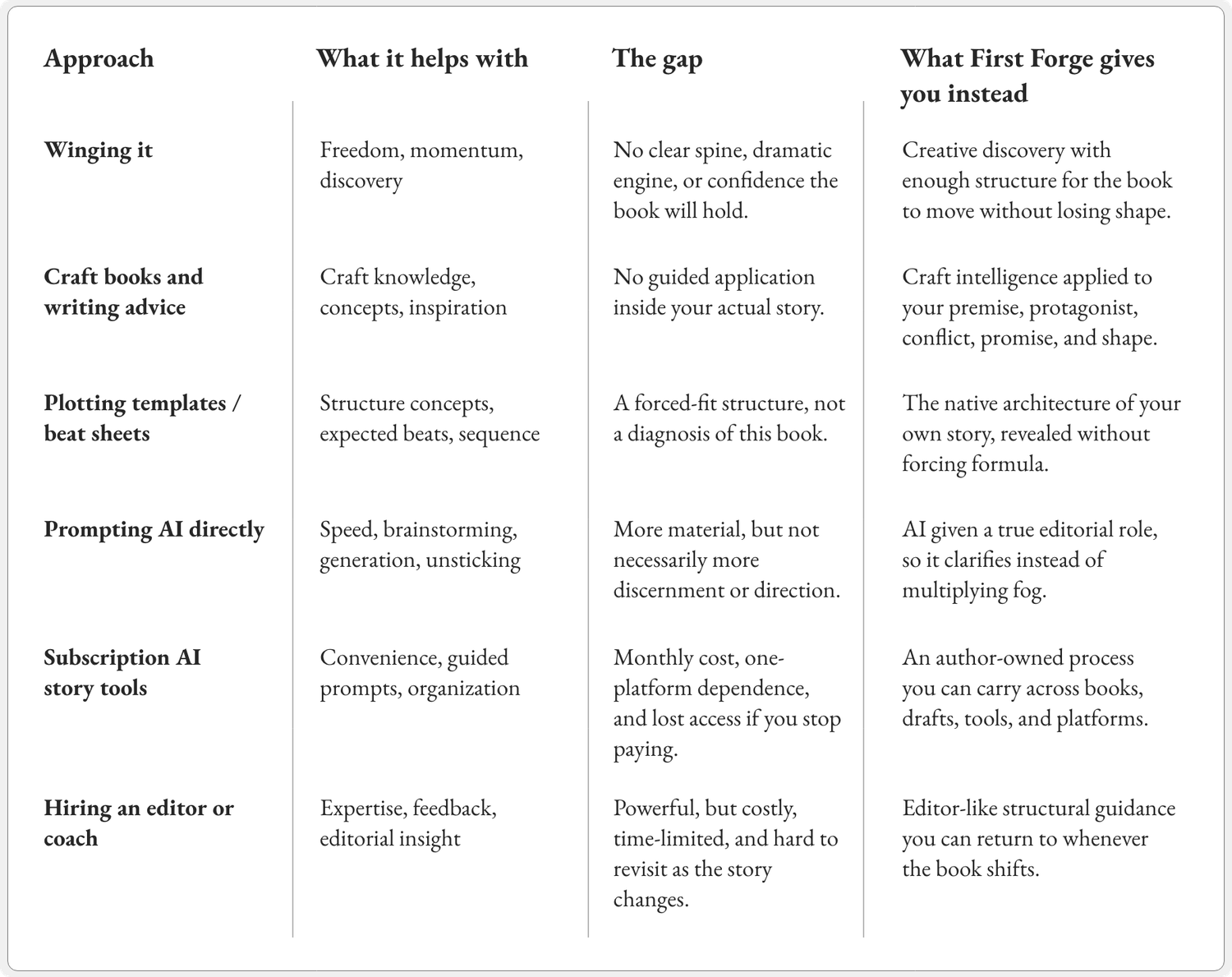
Every other path gives something real — then takes something back. A template lends you a shape and charges your story to fit it. A subscription vanishes the day you stop paying. An editor helps once — but your book keeps moving.
You shouldn't have to rent the way you write.
First Forge is the one you own — your material's own architecture, permanent, reusable across every draft and every book you'll ever write.
Everything Else is borrowed. This one’s yours
A template forces your story into its shape. A subscription disappears when you stop paying. An editor helps once but your book keeps moving.
You shouldn't have to rent the way you write.
First Forge is the one you own — reusable across every book you'll ever write.



Idea Forge starts with a spark.
Plot Forge starts with a premise.
Craft Codex starts with a single question.
You can come to First Forge at any stage. Here's one writer's starting point:
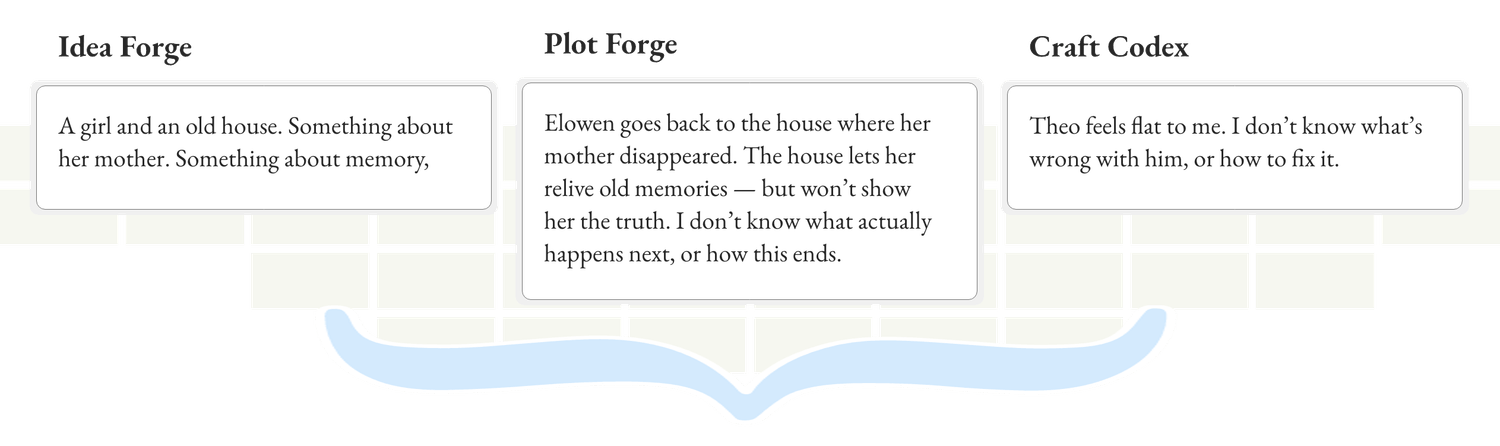
Here's what each one became — open any section below to see exactly what came back.
Idea Forge
The first chamber: where the story becomes nameable.
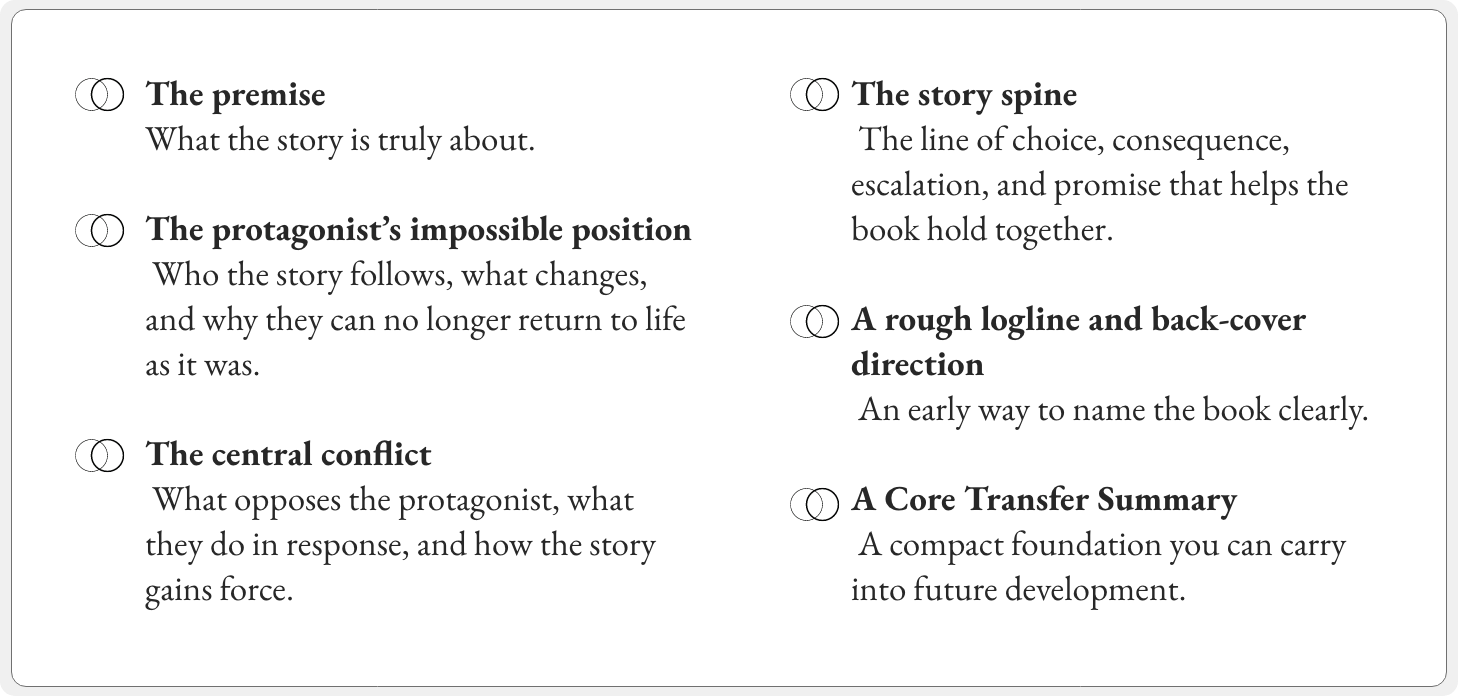
Raw story material takes its first clear shape here: premise, protagonist, central conflict, story promise, logline, and rough back-cover direction.
The first chamber: where the story becomes nameable.
Raw story material takes its first clear shape here: premise, protagonist, central conflict, story promise, logline, and rough back-cover direction.
Raw story material takes its first clear shape here: protagonist, pressure, central conflict, story promise, logline, and rough back-cover direction — the living foundation the book needs before it can be built.
The sample below shows one writer's raw idea — a single image and a feeling — moving through that process. One excerpt from a layered system where each output builds on the last. Not a complete picture of what Idea Forge produces, but one visible piece of what it looks like when loose material begins to reveal the book it wants to become.
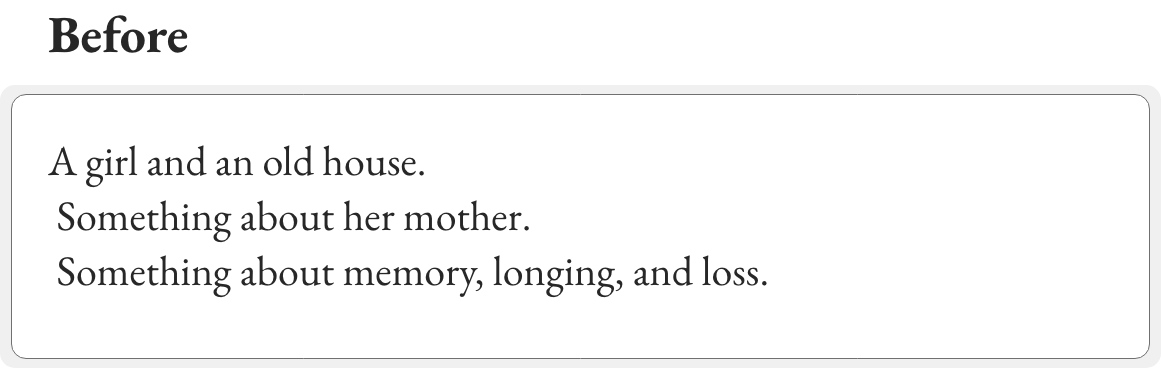
After: Rough logline
When seventeen-year-old Elowen receives a letter from the abandoned house where her mother disappeared, she enters a labyrinth of living memories that keeps offering her the version of the past she needs most, while hiding the truth her family has spent years trying not to hear.
After: Rough Premise Blurb
Seventeen-year-old Elowen has spent half her life living around the locked room of her mother’s disappearance. When she was nine, her mother entered the abandoned house at the edge of town and never came back. Her father sealed that night in silence. Her younger brother, Theo, sharpened it into anger. Elowen made it holy with longing.
Then a letter arrives from inside the house. The handwriting is her mother’s. The message is only four words:
I am still here.
Inside, the house opens memories as rooms Elowen can step into. A Christmas party glows with snowlight. Her mother fixes the ribbon on Elowen’s dress. Music plays. Candles shine. For one impossible moment, the family seems whole.
But there is a locked door at the edge of the room.
Each time Elowen reaches for it, the house pulls her back into the warmth. Her mother says her name. The music begins again. The snowlight softens everything.
Somewhere beyond the door, Theo is crying.
At first, the house gives Elowen what she longs for: her mother tender, radiant, almost reachable. But every time she moves closer to what really happened, the rooms shift. Doors seal. Conversations restart before the crucial sentence. The house offers tenderness at every threshold, as if wanting the truth is a betrayal of love.
Slowly, Elowen realizes the house is not hiding only the night her mother vanished. It is hiding the days before it: her mother returning from the house too calm, too far away; her father knowing and saying nothing; Theo hearing enough to know the story they were given was not true.
The house keeps offering the memory that hurts least. It does not show the past as it happened. It shows what the wound remembers. And somewhere inside, her mother is still waiting, preserved in the version of love Elowen needed in order to survive.
To learn the truth, Elowen must open the locked door inside the beautiful memory, follow Theo’s crying into the rooms no one wanted to enter, leave behind the only mother who can still answer her, and carry home the sentence her family has spent years trying not to hear.
After: Elevated Premise Articulation
At its strongest, The House That Remembers is not only a disappearance mystery. It is a literary speculative novel about the mercy and danger of false memories: the versions of love we create when the truth would break us too soon.
Its central image is unforgettable: a haunted house that does not hold ghosts, but preserved versions of what a family could not bear to remember honestly.
After: Agent Pitch Line
When seventeen-year-old Elowen enters the house where her mother vanished, she must open the locked door inside her most cherished memory or lose the truth forever.
After: Market Positioning
The House That Remembers sits where literary speculative fiction, gothic mystery, and emotionally driven family drama meet. Its hook is immediate: a girl enters the abandoned house where her mother disappeared and discovers that memory has become inhabitable.
What makes the premise singular is the haunting’s emotional architecture. The house does not reveal what happened. It reveals what the wound preserved. The promise is atmospheric, intimate, and unsettling: a mystery about grief, family silence, and the stories children build when love and abandonment arrive in the same room.
What Changed
The raw material is still there. Idea Forge helps the book inside it come into view: protagonist, wound, pressure, promise, pitch, market shape, and first living architecture.
Plot Forge
The second chamber: where the book finds its path.
The premise becomes story architecture here: cause, consequence, escalation, middle movement, climax, and ending direction shaped so the novel can travel as a whole.
Plot Forge creates far more than a story map. It reveals the structural logic beneath the story: cause and consequence, escalation, reversal, crisis, climax, and resolution.
The sample below shows a premise becoming a dramatic whole: pressure, pattern, cost, and payoff locking into one coherent story path.
Before
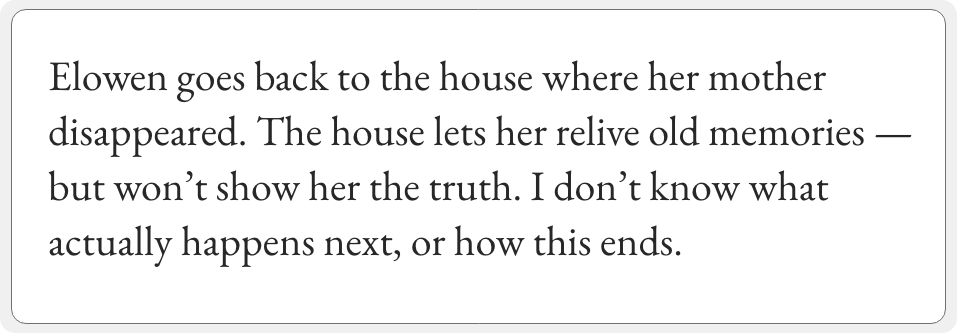
After: Plot Forge Story Map
THE HOUSE THAT REMEMBERS
This is a Plot Forge story map rendered into narrative form — a shortened sample, compressed for this page. A full output goes deeper.
Plot Ignition
Seventeen-year-old Elowen has spent half her life living around the locked room of her mother’s disappearance. When she was nine, her mother entered the abandoned house at the edge of town and never truly came back. Her father sealed that night in silence. Theo turned it into anger. Elowen turned it into longing.
Then a letter arrives from the same house. No one lives there. No one has for years. The handwriting belongs to her mother. The message is only four words: I am still here.
Elowen cannot leave it unanswered. Ignoring it means losing her only chance to understand what happened. Answering it means entering the place her family has avoided for eight years. When she returns, a door appears on the side wall where no door has ever been.
The past is no longer silent. It has opened.
Escalation Ladder
At first, the house gives Elowen what she wants: gentle memories of her mother laughing in the kitchen, her father carrying candles through a hallway, Theo asleep with one hand curled around a toy fox. The rooms are warm, vivid, almost kind.
But each room has a seam. A voice stops before the important word. Elowen hears a cup break and turns to follow it, but the sound softens into rain before she finds the door. Her father says, “Not in front of them,” and the wall folds over the rest.
Then the house opens the Christmas room: Elowen’s most cherished memory. Her mother kneels to fix the ribbon on Elowen’s dress. Snow presses against the windows. Music plays. Theo is laughing nearby. For one breath, the family seems untouched by loss.
But there is a locked door at the edge of the room, and Elowen does not remember it.
Each time she crosses the room, the house gives her the beautiful version again: her mother smiling, the candles brighter, the music restarting. If Elowen turns away, the room warms. If she reaches for the door, the music warps, her mother’s hands tremble, and Theo’s laughter thins into crying. The house pulls her back.
Outside the house, the pressure follows her home. Theo refuses to let Elowen make their mother beautiful. He remembers the kitchen door closing, their mother’s coat, their father telling him he dreamed what he heard, and crying upstairs while everyone pretended not to know why.
At first, Elowen thinks Theo’s anger is another locked door. Then she begins to understand: her mother’s voice leads to the memory that hurts least. Theo’s broken memory leads toward the one that is true.
With every return, the cost sharpens. Elowen’s version costs Theo the right to be believed. Theo’s version costs Elowen the mother she needed. Their father’s version costs everyone speech. The house’s version costs the truth itself. Every version costs someone.
Midpoint Break
The house leads Elowen to a blue room she barely remembers: a quiet afternoon before the disappearance. Her mother sits beside her on the floor, showing her how to fold paper birds. Light moves over the walls like water. For a moment, nothing hurts.
The memory is real. The tenderness was real. The love was real. Then Elowen notices what never happens. The paper birds never finish unfolding. Her mother never rises to answer the voice calling from another room. The memory keeps circling the part where love is easiest to bear.
The house preserves real love by cutting it away from the truth around it. The letter was true, but not in the way Elowen needed. I am still here was not a promise that her mother could return. It was a summons to retrieve what the house had been holding.
Now Elowen knows where she has to go: back to the Christmas room, back to the locked door, back through the memory she most wants to keep.
Crisis + Climactic Choice
The house opens the Christmas room one final time. Everything is more beautiful than before. The candles shine brighter. The snow falls in slow, impossible flakes. Her mother kneels in front of her, tying the ribbon on Elowen’s dress with hands that do not tremble.
“Stay here,” her mother says. “You were happy here.” And Elowen was. That is what makes it cruel.
The love was real. But the memory is incomplete, and Theo is crying behind the locked door. Elowen opens it.
Behind the door is the kitchen, years ago, on the night everything broke. Elowen is nine again, standing in the hallway while her parents argue in voices too low for children but not low enough to hide the truth. Theo is upstairs, crying. Her mother has her coat on. Her father is begging her not to go back to the house.
This was not the beginning of the leaving. It was the end. Her mother had been going back for months, slipping into rooms where pain paused and life did not ask so much of her. Her father knew. He hid the earlier visits because he thought he could stop the leaving before the children understood it was happening.
For years, Elowen remembered her mother promising she would come back. But that was the house’s softened version. In the true memory, Elowen asks, “Are you coming back?” Her mother closes her eyes. “I don’t know how to stay.”
The house offers the gentler version one final time: the promise, the return, the mother who could not leave. If Elowen accepts it, she can stay where her mother still knows how to love her back. If she refuses it, she has to carry home the truth: her mother loved them, she had been leaving in pieces long before the final night, her father knew more than he said, and Theo’s crying had been witness, not weakness.
Elowen chooses the true memory. She stops asking the house to turn her mother into someone who could have stayed, then walks out of the Christmas room while her mother’s preserved voice is still calling her name.
This is the cost: she has to leave the only mother who can still answer her.
The Christmas party empties. The locked door stands open. The kitchen falls quiet. The hallway opens into morning. The house can only hold what people cannot bear to remember honestly. Elowen has borne it.
Resolution Image
At dawn, Elowen leaves the house and goes home. Behind her, the house is still standing. But it no longer remembers for them.
Her father is waiting in the kitchen, looking like a man who has been holding his breath for eight years. Theo stands in the doorway, still angry, still afraid, but listening. Elowen does not return with a miracle. She brings back the history the family was built around not hearing.
“She had been going back before that night,” Elowen says. Her father closes his eyes. “You knew.” He nods once. It is not enough. It is the beginning of enough.
Elowen turns to Theo. “And you heard more than anyone let you say.” For the first time, no one corrects the truth into something easier. Then Elowen says the sentence that holds all of it without softening it: “She loved us. And she didn’t know how to stay.”
Theo begins to cry. This time, no hallway swallows the sound. No door closes over it. No one turns it into anger, silence, or snowlight. Their father does not look away. Elowen sits beside her brother, and the kitchen holds what the house no longer has to carry.
Final Integration
The letter had said, I am still here.
Now Elowen understands what was still there: not the mother she imagined, not the lie that saved her, but the wound, the love, and the truth.
The house is still there. But what remains is real.
Plot Forge helps build: what happens next, why each turn matters, what it costs, and how the whole story locks into one living shape.
Craft Codex
The refinement chamber: where the story is strengthened.
Return here when part of the story asks for deeper attention. Character, theme, conflict, world, genre, voice, symbol, emotional movement, and reader experience can be examined without losing the whole.
Bring Craft Codex a whole book, a scene, a character, a single line — or just the uneasy sense that something isn't yet alive. Ask it about conflict, character, theme, voice, world, structure, symbol, the way a scene lands on a reader — or come in with no idea what's wrong at all.
What comes back isn't a list of suggestions. It reads your story the way the rarest editors do — everything at once, and the way each part pulls on all the others.
It finds the strength you're leaning on so hard it crowds out the rest. The dimension your story keeps gesturing toward but never enters. The place your central value has curdled into its counterfeit. The two things that look unrelated and would, together, unlock the whole book.
Then it does the rarest thing of all. Near the end, you may see a line that begins Live Wire — the single most important thing in your material that you never thought to ask about: the deeper story beneath the story you came in with. It's often the truest sentence in the response, and the one writers still remember weeks later.
And it works at any scale, without ever thinning out. Bring it the novel, it reads the novel. Bring it one sentence, it reads that sentence just as deeply — because every part of a story holds the whole story in miniature, and Craft Codex is built to see it there. Every other tool gives you less as you narrow in. This gives you more.
Underneath every read is a single question: what would make this story most fully itself? Not more dramatic, not more marketable — more itself.
The sample below shows a writer bringing one small question about a secondary character — and getting back something that reorganizes how they see the entire book. On the other side, the feeling is always the same: oh — that's exactly what it needed, and I couldn't see it yet.
The question the writer brought
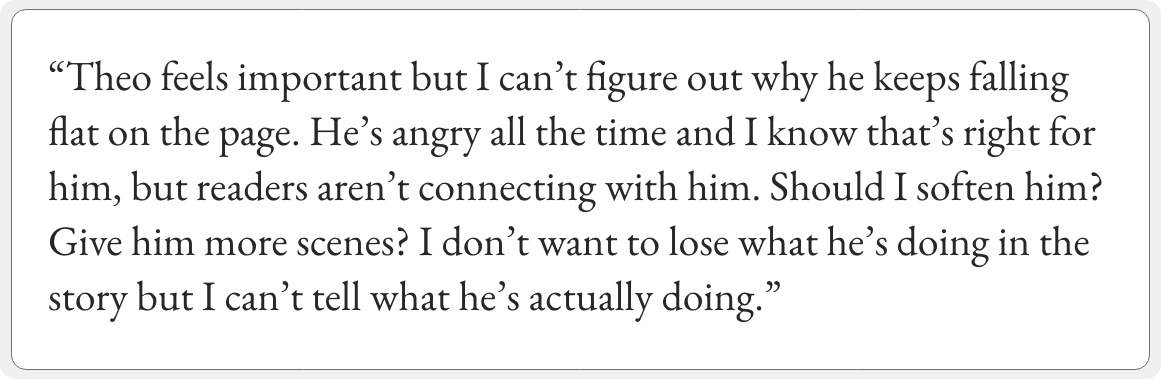
CRAFT CODEX RESPONSE:
Theo isn't flat because he needs softening or more scenes. He's flat because neither you nor the reader yet fully understands what he structurally is — and until you do, every scene he's in will feel like friction instead of function.
What Theo actually is
Theo is not a secondary character in the conventional sense. He is the story's only honest witness — and that is a structural role, not a character trait. Every other consciousness in this story has made a private peace with a version of what happened that is easier to live with. Her father chose silence. The house offers beautiful substitutes. Elowen, until the end, chooses longing over truth. Theo alone has refused the softened version — not because he is harder, but because he was present in a way the others weren't, and what he heard has never stopped being true.
His anger is not a character flaw to be managed. It is the story's immune response — the one force in the narrative that keeps pointing at what actually happened, even when everything else is conspiring to make it beautiful.
This is why he falls flat when written primarily as a problem Elowen has to navigate. The moment he functions as an obstacle to her grief, he loses his structural purpose. He stops being the story's truth and becomes its friction.
The grief-mirror Elowen hasn't seen
Theo and Elowen are not in opposition. They are in grief-mirror. They loved the same mother. They lost the same night. But where Elowen preserved her mother by making her beautiful — by making the longing holy — Theo preserved her by refusing to let the lie stand. Both are acts of love. Opposite methods of keeping something real. Neither of them knows that yet. The story does, and the reader needs to feel it before the climax, or Theo's role in the final scene will read as a convenience rather than an inevitability.
The house cannot work on him — and that is load-bearing
The house reads Elowen with precision. It finds the exact memory she most needs and offers it. It is extraordinarily good at this. It has had years of practice with people who want to be comforted.
Theo does not receive that treatment. The house has nothing beautiful to offer him because he has never let it revise what he knows. His body — the specific physical register of his anger, the way it closes rather than opens toward warmth — is something the house cannot translate into tenderness. He is the one character the seduction machine cannot run on.
In a story where the central dramatic mechanism is a house that creates false movement — that gives the protagonist the feeling of getting closer while actually keeping her circling — Theo is the only force that produces real movement. His presence in a scene doesn't escalate the atmosphere. It breaks it. That is a far more important structural function than being Elowen's difficult brother.
Why he feels flat: the POV problem
You are almost certainly writing him entirely through Elowen's perception — which means the reader receives him the way Elowen does: as resistance, as someone who won't let her grieve the way she needs to. The reader feels that Elowen finds him difficult. They cannot yet feel what it costs Theo to be the only one in the family still standing in the truth.
You do not need to shift POV chapters to fix this. You need one moment — probably a single scene, possibly a single paragraph — where Elowen notices something specific and physical about him that she doesn't have a comfortable explanation for. Not his anger. Something quieter. The way he keeps the toy fox his mother gave him, but face-down in a drawer. The way he never corrects people when they get the story wrong — not because he agrees, but because correcting them stopped being worth the cost. Something that lets the reader feel, briefly, what it is to carry what he carries without the house ever having offered to make it easier.
When the reader understands that Theo's anger is the most faithful love in the book — the love that refused to become a lie — he will stop reading as difficult. He will read as devastating.
THE SAME QUESTION AT DIFFERENT SCALES
Craft Codex can work at the scale you need — whole book, scene, or a single line. Here is what that looks like for this specific story problem.
At whole-book scale:
The Theo problem is not only a character problem. It is a structural signal that the book currently has two registers — the house's seductive, atmospheric, lyrical pull, and Theo's resistant, unbeautiful, ground-level truth — and they are not yet in conscious conversation with each other. When Theo lands correctly, those two registers become the book's central argument: the seductive version of love versus the faithful one. That argument needs to be present from early in the book, not just in the climax. Look at your first three Theo appearances. Is the gap between his register and the house's register already doing meaningful work, or is he simply marking time until the ending needs him?
At scene scale:
Take any scene where Theo and Elowen are in the same space. Run this test: does the scene end with the house's logic still intact, or has Theo's presence cracked something in it? If the house's version of events is still the dominant reality when the scene closes, Theo has been written as atmosphere rather than as force. A scene that uses Theo correctly should leave a small fracture in the beautiful version — something the reader notices even if Elowen does not. The fracture doesn't have to be dramatic. Theo says something that doesn't quite fit the story the family has been telling. Elowen moves past it. The reader can't.
At line scale:
Consider a line like: Theo stood in the doorway, still angry, still afraid, but listening.
This line appears in the resolution of your Plot Forge story map. It is doing important emotional work but it is naming the states rather than showing them. "Still angry, still afraid" are interpretations — Elowen's read of him, or the narrator's. They keep the reader at the same distance that has been making him flat. One way to find the line beneath the line: remove the interpretations and give the reader his body instead. What is Theo actually doing in the doorway that reads as still angry, still afraid, but listening? The specific physical detail — the thing only Theo would do in that specific moment — is where the reader finally gets to stand next to him rather than watch him from across the room.
LIVE WIRE
The house is not a setting. It is the story’s most powerful character — the one with the clearest desire, the longest memory, and the most consistent method. It selects, withholds, offers, and repeats, not randomly but with preference. Every other character is trying to survive their grief. The house is trying to keep it. Ask what the house wants from Elowen specifically, and the story will show you something it has not yet shown you.
WHAT CHANGED
The writer came in asking whether to soften a character or add scenes. The answer moved through his structural function, his role in the story's central mechanism, the specific POV problem creating the flatness, and then down through three scales — whole book, scene, line — each one showing a different place to put their hands on the same problem.
No framework was named. No dimension was listed. The story was read as a living system and the diagnosis followed what was actually there.
This is what Craft Codex does. It finds the thing beneath the thing you asked about — and then shows you exactly where to put your hands.
Supporting Materials
The operating layer that helps the Forges run clearly.
First Forge also includes AI Operations Manuals, starting guides, story-record tools, and refinement support to help you use the system with confidence.


Idea Forge AI Operations Manual
The execution manual that tells the AI how to run Idea Forge, so the process stays structured, accurate, and aligned.
Plot Forge AI Operations Manual
The execution manual that tells the AI how to run Plot Forge with consistency, depth, and author-led precision.
Craft Codex AI Operations Manual
The execution manual that tells the AI how to run Craft Codex, so story questions are explored with precision, depth, and alignment to the larger system.

Start Here
A simple starting guide that shows you the order of the system and how to begin.
Forge Guide
The companion guide for moving through a Story Imaginarium Forge: how to set up your AI workspace, move step by step, run the right passes, choose canon, and carry your story into the next stage.
Idea Forge Quickstart
A lighter entry point to help you begin Idea Forge quickly and clearly.
Complete System Guide
This guides you through the entire First Forge System.

Story Operating Core
Your central story record, where the canonical core of your book is carried forward as you build.
The Forge Refinement Companion
A practical guide for using the Craft Codex to smooth, simplify, and strengthen your Idea Forge and Plot Forge outputs.
Everything starts with something small — a spark, a premise, a question
You can come to First Forge at any stage. Here's one writer's starting point:

Here's what each one became — open any section below to see exactly what came back.
Idea Forge
Raw story material takes its first clear shape here: protagonist, pressure, central conflict, story promise, logline, and rough back-cover direction — the living foundation the book needs before it can be built.
The sample below shows one writer's raw idea — a single image and a feeling — moving through that process. One excerpt from a layered system where each output builds on the last. Not a complete picture of what Idea Forge produces, but one visible piece of what it looks like when loose material begins to reveal the book it wants to become.
Before

After: rough logline
When seventeen-year-old Elowen receives a letter from the abandoned house where her mother disappeared, she enters a labyrinth of living memories that keeps offering her the version of the past she needs most, while hiding the truth her family has spent years trying not to hear.
After: rough premise blurb
Seventeen-year-old Elowen has spent half her life living around the locked room of her mother’s disappearance. When she was nine, her mother entered the abandoned house at the edge of town and never came back. Her father sealed that night in silence. Her younger brother, Theo, sharpened it into anger. Elowen made it holy with longing.
Then a letter arrives from inside the house. The handwriting is her mother’s. The message is only four words: I am still here.
Inside, the house opens memories as rooms Elowen can step into. A Christmas party glows with snowlight. Her mother fixes the ribbon on Elowen’s dress. Music plays. Candles shine. For one impossible moment, the family seems whole.
But there is a locked door at the edge of the room.
Each time Elowen reaches for it, the house pulls her back into the warmth. Her mother says her name. The music begins again. The snowlight softens everything. Somewhere beyond the door, Theo is crying.
At first, the house gives Elowen what she longs for: her mother tender, radiant, almost reachable. But every time she moves closer to what really happened, the rooms shift. Doors seal. Conversations restart before the crucial sentence. The house offers tenderness at every threshold, as if wanting the truth is a betrayal of love.
Slowly, Elowen realizes the house is not hiding only the night her mother vanished. It is hiding the days before it: her mother returning from the house too calm, too far away; her father knowing and saying nothing; Theo hearing enough to know the story they were given was not true.
The house keeps offering the memory that hurts least. It does not show the past as it happened. It shows what the wound remembers. And somewhere inside, her mother is still waiting, preserved in the version of love Elowen needed in order to survive.
To learn the truth, Elowen must open the locked door inside the beautiful memory, follow Theo’s crying into the rooms no one wanted to enter, leave behind the only mother who can still answer her, and carry home the sentence her family has spent years trying not to hear.
After: Elevated Premise Articulation
At its strongest, The House That Remembers is not only a disappearance mystery. It is a literary speculative novel about the mercy and danger of false memories: the versions of love we create when the truth would break us too soon.
Its central image is unforgettable: a haunted house that does not hold ghosts, but preserved versions of what a family could not bear to remember honestly.
After: Elevated Premise Articulation
When seventeen-year-old Elowen enters the house where her mother vanished, she must open the locked door inside her most cherished memory or lose the truth forever.
After: Market Positioning
The House That Remembers sits where literary speculative fiction, gothic mystery, and emotionally driven family drama meet. Its hook is immediate: a girl enters the abandoned house where her mother disappeared and discovers that memory has become inhabitable.
What makes the premise singular is the haunting’s emotional architecture. The house does not reveal what happened. It reveals what the wound preserved. The promise is atmospheric, intimate, and unsettling: a mystery about grief, family silence, and the stories children build when love and abandonment arrive in the same room.
What changed
The raw material is still there. Idea Forge helps the book inside it come into view: protagonist, wound, pressure, promise, pitch, market shape, and first living architecture.
Plot Forge
Plot Forge creates far more than a story map. It reveals the structural logic beneath the story: cause and consequence, escalation, reversal, crisis, climax, and resolution.
The sample below shows a premise becoming a dramatic whole: pressure, pattern, cost, and payoff locking into one coherent story path.
Before

After: Plot Forge Story Map
THE HOUSE THAT REMEMBERS
This is a Plot Forge story map rendered in narrative form — a shortened sample, compressed for this page. A full output goes deeper.
Plot Ignition
Seventeen-year-old Elowen has spent half her life living around the locked room of her mother’s disappearance. When she was nine, her mother entered the abandoned house at the edge of town and never truly came back. Her father sealed that night in silence. Theo turned it into anger. Elowen turned it into longing.
Then a letter arrives from the same house. No one lives there. No one has for years. The handwriting belongs to her mother. The message is only four words: I am still here.
Elowen cannot leave it unanswered. Ignoring it means losing her only chance to understand what happened. Answering it means entering the place her family has avoided for eight years. When she returns, a door appears on the side wall where no door has ever been.
The past is no longer silent. It has opened.
Escalation Ladder
At first, the house gives Elowen what she wants: gentle memories of her mother laughing in the kitchen, her father carrying candles through a hallway, Theo asleep with one hand curled around a toy fox. The rooms are warm, vivid, almost kind.
But each room has a seam. A voice stops before the important word. Elowen hears a cup break and turns to follow it, but the sound softens into rain before she finds the door. Her father says, “Not in front of them,” and the wall folds over the rest.
Then the house opens the Christmas room:
Elowen’s most cherished memory. Her mother kneels to fix the ribbon on Elowen’s dress. Snow presses against the windows. Music plays. Theo is laughing nearby. For one breath, the family seems untouched by loss.
But there is a locked door at the edge of the room, and Elowen does not remember it.
Each time she crosses the room, the house gives her the beautiful version again: her mother smiling, the candles brighter, the music restarting. If Elowen turns away, the room warms. If she reaches for the door, the music warps, her mother’s hands tremble, and Theo’s laughter thins into crying. The house pulls her back.
Outside the house, the pressure follows her home. Theo refuses to let Elowen make their mother beautiful. He remembers the kitchen door closing, their mother’s coat, their father telling him he dreamed what he heard, and crying upstairs while everyone pretended not to know why.
At first, Elowen thinks Theo’s anger is another locked door. Then she begins to understand: her mother’s voice leads to the memory that hurts least. Theo’s broken memory leads toward the one that is true.
With every return, the cost sharpens. Elowen’s version costs Theo the right to be believed. Theo’s version costs Elowen the mother she needed. Their father’s version costs everyone speech. The house’s version costs the truth itself. Every version costs someone.
Midpoint Break
The house leads Elowen to a blue room she barely remembers: a quiet afternoon before the disappearance. Her mother sits beside her on the floor, showing her how to fold paper birds. Light moves over the walls like water. For a moment, nothing hurts.
The memory is real. The tenderness was real. The love was real. Then Elowen notices what never happens. The paper birds never finish unfolding. Her mother never rises to answer the voice calling from another room. The memory keeps circling the part where love is easiest to bear.
The house preserves real love by cutting it away from the truth around it. The letter was true, but not in the way Elowen needed. I am still here was not a promise that her mother could return. It was a summons to retrieve what the house had been holding.
Now Elowen knows where she has to go: back to the Christmas room, back to the locked door, back through the memory she most wants to keep.
Crisis + Climactic Choice
The house opens the Christmas room one final time. Everything is more beautiful than before. The candles shine brighter. The snow falls in slow, impossible flakes. Her mother kneels in front of her, tying the ribbon on Elowen’s dress with hands that do not tremble.
“Stay here,” her mother says. “You were happy here.” And Elowen was. That is what makes it cruel.
The love was real. But the memory is incomplete, and Theo is crying behind the locked door. Elowen opens it.
Behind the door is the kitchen, years ago, on the night everything broke. Elowen is nine again, standing in the hallway while her parents argue in voices too low for children but not low enough to hide the truth. Theo is upstairs, crying. Her mother has her coat on. Her father is begging her not to go back to the house.
This was not the beginning of the leaving. It was the end. Her mother had been going back for months, slipping into rooms where pain paused and life did not ask so much of her. Her father knew. He hid the earlier visits because he thought he could stop the leaving before the children understood it was happening.
For years, Elowen remembered her mother promising she would come back. But that was the house’s softened version. In the true memory, Elowen asks, “Are you coming back?” Her mother closes her eyes. “I don’t know how to stay.”
The house offers the gentler version one final time: the promise, the return, the mother who could not leave. If Elowen accepts it, she can stay where her mother still knows how to love her back. If she refuses it, she has to carry home the truth: her mother loved them, she had been leaving in pieces long before the final night, her father knew more than he said, and Theo’s crying had been witness, not weakness.
Elowen chooses the true memory. She stops asking the house to turn her mother into someone who could have stayed, then walks out of the Christmas room while her mother’s preserved voice is still calling her name.
This is the cost: she has to leave the only mother who can still answer her.
The Christmas party empties. The locked door stands open. The kitchen falls quiet. The hallway opens into morning. The house can only hold what people cannot bear to remember honestly. Elowen has borne it.
Resolution Image
At dawn, Elowen leaves the house and goes home. Behind her, the house is still standing. But it no longer remembers for them.
Her father is waiting in the kitchen, looking like a man who has been holding his breath for eight years. Theo stands in the doorway, still angry, still afraid, but listening. Elowen does not return with a miracle. She brings back the history the family was built around not hearing.
“She had been going back before that night,” Elowen says. Her father closes his eyes. “You knew.” He nods once. It is not enough. It is the beginning of enough.
Elowen turns to Theo. “And you heard more than anyone let you say.” For the first time, no one corrects the truth into something easier. Then Elowen says the sentence that holds all of it without softening it: “She loved us. And she didn’t know how to stay.”
Theo begins to cry. This time, no hallway swallows the sound. No door closes over it. No one turns it into anger, silence, or snowlight. Their father does not look away. Elowen sits beside her brother, and the kitchen holds what the house no longer has to carry.
Final Integration
The letter had said, I am still here.
Now Elowen understands what was still there: not the mother she imagined, not the lie that saved her, but the wound, the love, and the truth.
The house is still there. But what remains is real.
Plot Forge helps build: what happens next, why each turn matters, what it costs, and how the whole story locks into one living shape.
Craft Codex
Bring Craft Codex a whole book, a scene, a character, a single line — or just the uneasy sense that something isn't yet alive. Ask it about conflict, character, theme, voice, world, structure, symbol, the way a scene lands on a reader — or come in with no idea what's wrong at all.
What comes back isn't a list of suggestions. It reads your story the way the rarest editors do — everything at once, and the way each part pulls on all the others.
It finds the strength you're leaning on so hard it crowds out the rest. The dimension your story keeps gesturing toward but never enters. The place your central value has curdled into its counterfeit. The two things that look unrelated and would, together, unlock the whole book.
Then it does the rarest thing of all. Near the end, you may see a line that begins Live Wire — the single most important thing in your material that you never thought to ask about: the deeper story beneath the story you came in with. It's often the truest sentence in the response, and the one writers still remember weeks later.
And it works at any scale, without ever thinning out. Bring it the novel, it reads the novel. Bring it one sentence, it reads that sentence just as deeply — because every part of a story holds the whole story in miniature, and Craft Codex is built to see it there. Every other tool gives you less as you narrow in. This gives you more.
Underneath every read is a single question: what would make this story most fully itself? Not more dramatic, not more marketable — more itself.
The sample below shows a writer bringing one small question about a secondary character — and getting back something that reorganizes how they see the entire book. On the other side, the feeling is always the same: oh — that's exactly what it needed, and I couldn't see it yet.
The question the writer brought:

CRAFT CODEX RESPONSE:
Theo isn't flat because he needs softening or more scenes. He's flat because neither you nor the reader yet fully understands what he structurally is — and until you do, every scene he's in will feel like friction instead of function.
What Theo actually is
Theo is not a secondary character in the conventional sense. He is the story's only honest witness — and that is a structural role, not a character trait. Every other consciousness in this story has made a private peace with a version of what happened that is easier to live with. Her father chose silence. The house offers beautiful substitutes. Elowen, until the end, chooses longing over truth. Theo alone has refused the softened version — not because he is harder, but because he was present in a way the others weren't, and what he heard has never stopped being true.
His anger is not a character flaw to be managed. It is the story's immune response — the one force in the narrative that keeps pointing at what actually happened, even when everything else is conspiring to make it beautiful.
This is why he falls flat when written primarily as a problem Elowen has to navigate. The moment he functions as an obstacle to her grief, he loses his structural purpose. He stops being the story's truth and becomes its friction.
The grief-mirror Elowen hasn't seen
Theo and Elowen are not in opposition. They are in grief-mirror. They loved the same mother. They lost the same night. But where Elowen preserved her mother by making her beautiful — by making the longing holy — Theo preserved her by refusing to let the lie stand. Both are acts of love. Opposite methods of keeping something real. Neither of them knows that yet. The story does, and the reader needs to feel it before the climax, or Theo's role in the final scene will read as a convenience rather than an inevitability.
The house cannot work on him — and that is load-bearing
The house reads Elowen with precision. It finds the exact memory she most needs and offers it. It is extraordinarily good at this. It has had years of practice with people who want to be comforted.
Theo does not receive that treatment. The house has nothing beautiful to offer him because he has never let it revise what he knows. His body — the specific physical register of his anger, the way it closes rather than opens toward warmth — is something the house cannot translate into tenderness. He is the one character the seduction machine cannot run on.
In a story where the central dramatic mechanism is a house that creates false movement — that gives the protagonist the feeling of getting closer while actually keeping her circling — Theo is the only force that produces real movement. His presence in a scene doesn't escalate the atmosphere. It breaks it. That is a far more important structural function than being Elowen's difficult brother.
Why he feels flat: the POV problem
You are almost certainly writing him entirely through Elowen's perception — which means the reader receives him the way Elowen does: as resistance, as someone who won't let her grieve the way she needs to. The reader feels that Elowen finds him difficult. They cannot yet feel what it costs Theo to be the only one in the family still standing in the truth.
You do not need to shift POV chapters to fix this. You need one moment — probably a single scene, possibly a single paragraph — where Elowen notices something specific and physical about him that she doesn't have a comfortable explanation for. Not his anger. Something quieter. The way he keeps the toy fox his mother gave him, but face-down in a drawer. The way he never corrects people when they get the story wrong — not because he agrees, but because correcting them stopped being worth the cost. Something that lets the reader feel, briefly, what it is to carry what he carries without the house ever having offered to make it easier.
When the reader understands that Theo's anger is the most faithful love in the book — the love that refused to become a lie — he will stop reading as difficult. He will read as devastating.
THE SAME QUESTION AT DIFFERENT SCALES
Craft Codex can work at the scale you need — whole book, scene, or a single line. Here is what that looks like for this specific story problem.
At whole-book scale:
The Theo problem is not only a character problem. It is a structural signal that the book currently has two registers — the house's seductive, atmospheric, lyrical pull, and Theo's resistant, unbeautiful, ground-level truth — and they are not yet in conscious conversation with each other. When Theo lands correctly, those two registers become the book's central argument: the seductive version of love versus the faithful one. That argument needs to be present from early in the book, not just in the climax. Look at your first three Theo appearances. Is the gap between his register and the house's register already doing meaningful work, or is he simply marking time until the ending needs him?
At scene scale:
Take any scene where Theo and Elowen are in the same space. Run this test: does the scene end with the house's logic still intact, or has Theo's presence cracked something in it? If the house's version of events is still the dominant reality when the scene closes, Theo has been written as atmosphere rather than as force. A scene that uses Theo correctly should leave a small fracture in the beautiful version — something the reader notices even if Elowen does not. The fracture doesn't have to be dramatic. Theo says something that doesn't quite fit the story the family has been telling. Elowen moves past it. The reader can't.
At line scale:
Consider a line like: Theo stood in the doorway, still angry, still afraid, but listening.
This line appears in the resolution of your Plot Forge story map. It is doing important emotional work but it is naming the states rather than showing them. "Still angry, still afraid" are interpretations — Elowen's read of him, or the narrator's. They keep the reader at the same distance that has been making him flat. One way to find the line beneath the line: remove the interpretations and give the reader his body instead. What is Theo actually doing in the doorway that reads as still angry, still afraid, but listening? The specific physical detail — the thing only Theo would do in that specific moment — is where the reader finally gets to stand next to him rather than watch him from across the room.
LIVE WIRE
The house is not a setting. It is the story’s most powerful character — the one with the clearest desire, the longest memory, and the most consistent method. It selects, withholds, offers, and repeats, not randomly but with preference. Every other character is trying to survive their grief. The house is trying to keep it. Ask what the house wants from Elowen specifically, and the story will show you something it has not yet shown you.
WHAT CHANGED
The writer came in asking whether to soften a character or add scenes. The answer moved through his structural function, his role in the story's central mechanism, the specific POV problem creating the flatness, and then down through three scales — whole book, scene, line — each one showing a different place to put their hands on the same problem.
No framework was named. No dimension was listed. The story was read as a living system and the diagnosis followed what was actually there.
This is what Craft Codex does. It finds the thing beneath the thing you asked about — and then shows you exactly where to put your hands.
Supporting Materials
The operating layer that helps the Forges run clearly. First Forge also includes AI Operations Manuals, starting guides, story-record tools, and refinement support to help you use the system with confidence.
Idea Forge AI Operations Manual
The execution manual that tells the AI how to run Idea Forge, so the process stays structured, accurate, and aligned.
Plot Forge AI Operations Manual
The execution manual that tells the AI how to run Plot Forge with consistency, depth, and author-led precision.
Craft Codex AI Operations Manual
The execution manual that tells the AI how to run Craft Codex, so story questions are explored with precision, depth, and alignment to the larger system.
Start Here
A simple starting guide that shows you the order of the system and how to begin.
Forge Guide
The companion guide for moving through a Story Imaginarium Forge: how to set up your AI workspace, move step by step, run the right passes, choose canon, and carry your story into the next stage.
Idea Forge Quickstart
A lighter entry point to help you begin Idea Forge quickly and clearly.
Complete System Guide
This guides you through the entire First Forge System.
Story Operating Core
Your central story record, where the canonical core of your book is carried forward as you build.
The Forge Refinement Companion
A practical guide for using the Craft Codex to smooth, simplify, and strengthen your Idea Forge and Plot Forge outputs.

Why novels fail — and how FIRST FORGE prevents it
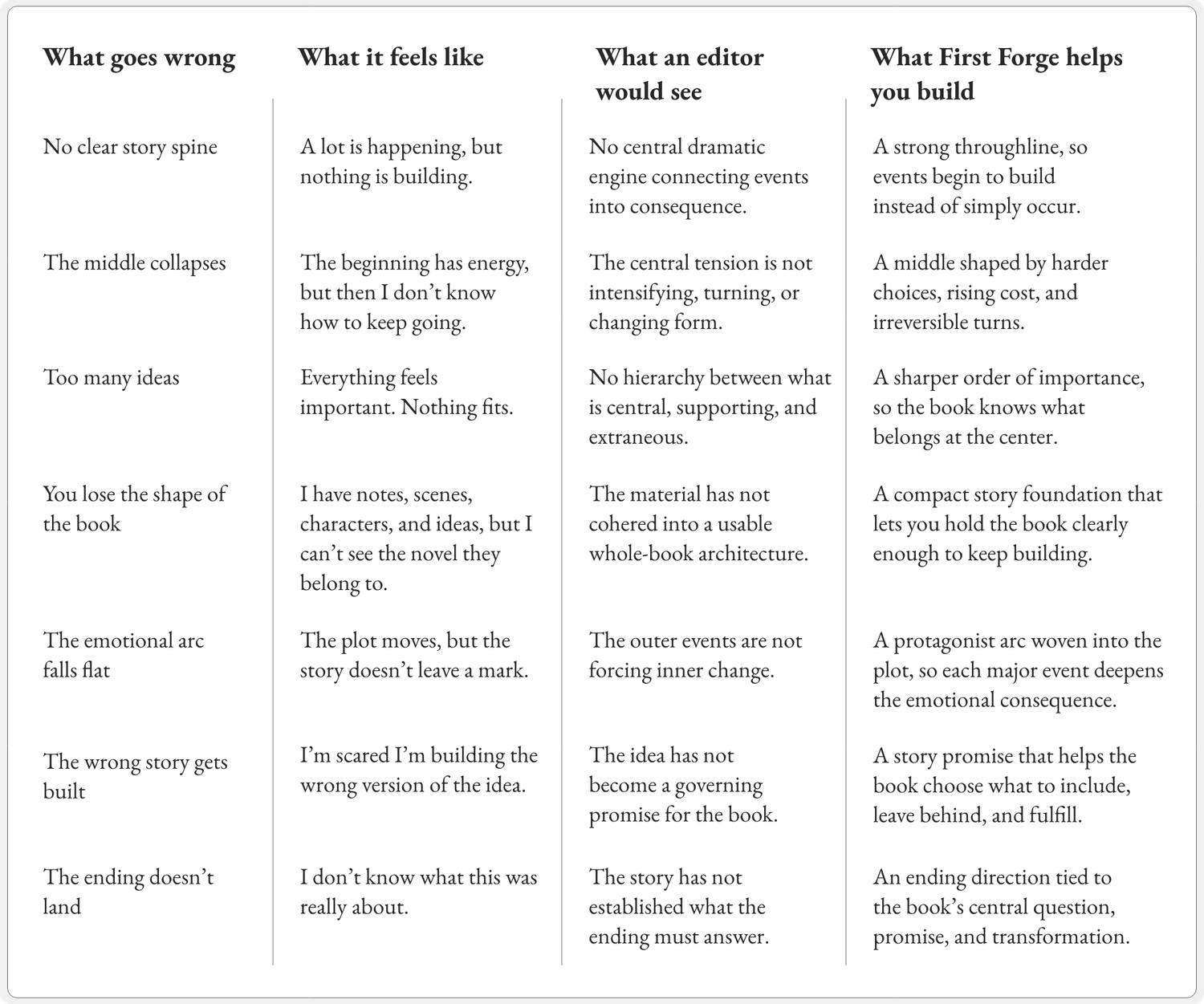
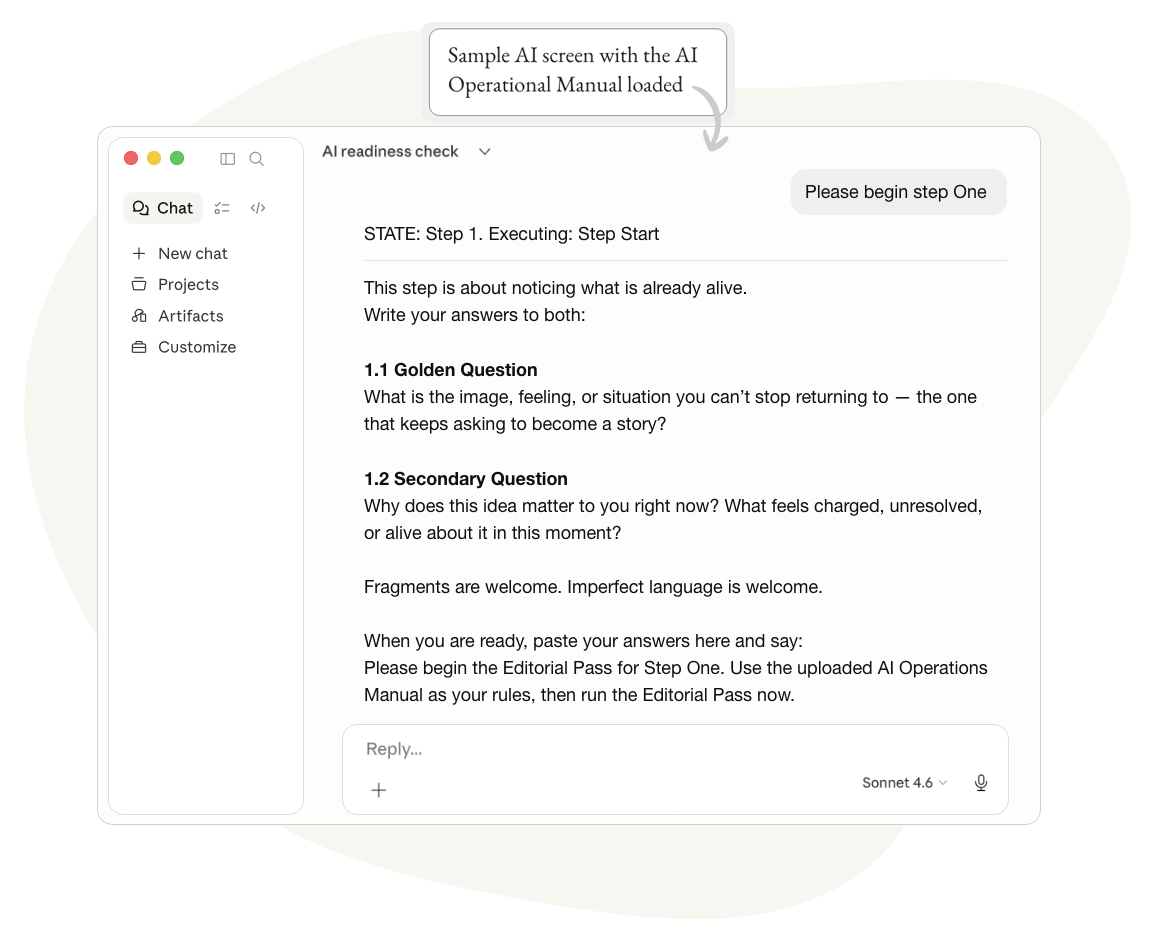
What writers say after First Forge
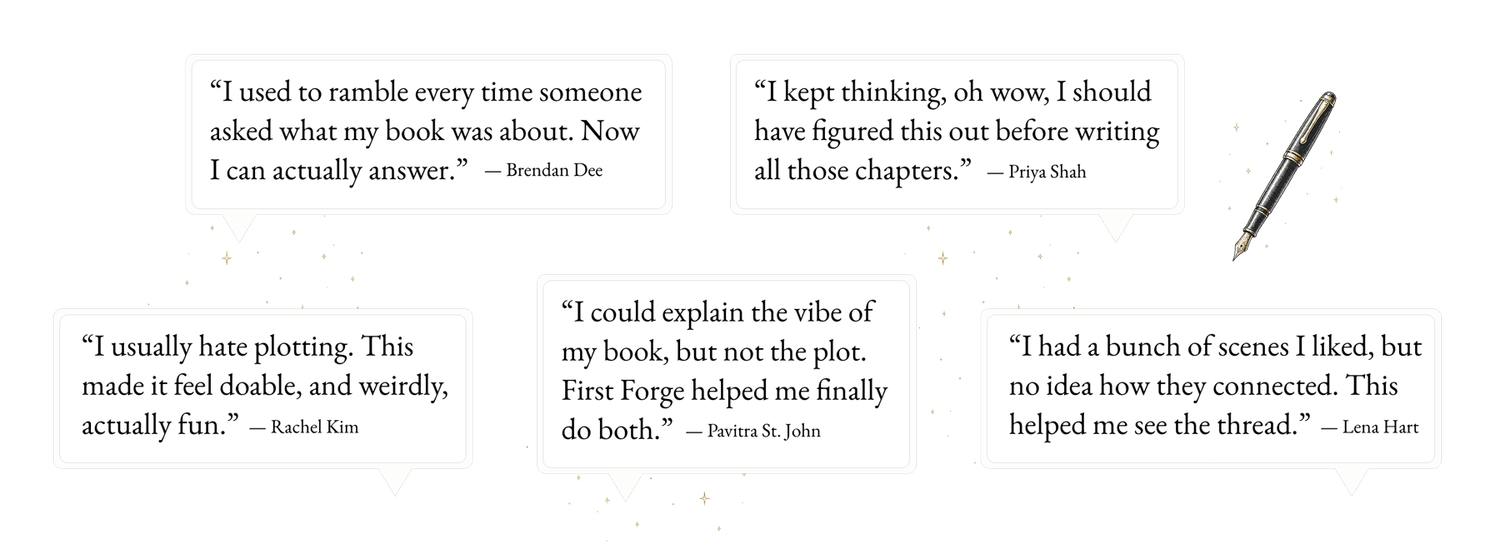
What writers say after First Forge



Questions writers ask
That's not a problem. That's a starting point — quite possibly the best one.
Here's something most writing advice gets wrong: a vague idea isn't an incomplete story. It's a story that hasn't been asked the right questions yet. The image that keeps returning. The character whose voice you can almost hear. The situation that carries emotional weight you can't quite explain. These aren't fragments of something missing. They're signals — and signals can be read.
Most writers try to solve vagueness by generating more material: more plot, more characters, more world. The idea gets bigger, not clearer, and what was alive at the center starts disappearing under the accumulation.
First Forge works the other way. Instead of building outward from a vague idea, it asks precise developmental questions that go inward — into what the idea is already carrying, what pressure is alive inside it, what kind of story it's actually trying to become.
You don't need more material. You need the right questions, asked in the right order. A spark, an image, a feeling, a character who won't leave you alone — that's enough. If your story currently exists as a Notes app entry, a half-formed character, and the strong conviction that something is there, congratulations: that’s not failure. That’s raw material. First Forge will show you how to build it.
Then you may need First Forge more urgently than the writer who's just beginning.
Here's the paradox no one warns you about: the more material you accumulate without a clear structural foundation, the harder it becomes to see the book. Scenes multiply. Characters deepen. The world gets richer. And somewhere underneath all of it, the actual story — the premise that should be load-bearing, the spine that should be pulling everything forward — is buried under the weight of what you've built on top of it.
You can feel it. Something isn't holding. The draft keeps sprawling. You add more scenes hoping one of them will solve the problem you can't quite name. The middle won't move. The ending won't come. You care deeply about this material and can't figure out why it isn't becoming a book yet.
At some point, “just one more scene” stops being a writing strategy and starts becoming a very elegant way to avoid looking at the foundation.
This isn't a talent problem. It's a visibility problem. You're too close to the material, and the material's too large, to see the shape underneath it — or the absence of one.
First Forge gives you a way to step back from everything you've built and ask the foundational questions: What is this story actually about, at its core? Does the premise have the load-bearing strength to carry everything you've written? Where is the spine — and is it intact? What belongs, what's circling without landing, and what's only making the story louder without making it stronger?
You don't have to abandon what you've written. You have to understand what it is — and what it still needs to become.
You can use First Forge at almost any stage if you need help seeing the shape of the story.
Then you're in exactly the right place. First Forge assumes nothing except that you have something alive in you and you want to turn it into a book.
Here's how it works. First Forge is the development system for the foundation of a novel — the part everything else has to stand on. Three tools take you from whatever you have now to a book that holds. Idea Forge finds the story alive in your material. Plot Forge builds its spine. Craft Codex stays with you throughout: any question of craft, at any scale, for as long as the book takes. You bring the story. The system helps you architect what sits underneath it, so everything you build on top has something true to stand on.
Some writers arrive with no clear map for getting it onto the page. Some arrive with half a map. Some already know the vocabulary and want to go deeper, faster. All of them belong here. The system introduces each element as you encounter it: what it is, why it matters to this story, and what to do with it. You don't have to memorize any storycraft before you begin. You begin, and the study happens inside the work.
Which leads to the part most writers don't see coming.
You walk away knowing more than you came in with. Not trivia. Craft intelligence itself: the deep sight that separates writing that works from writing that has merely learned to stand near good writing and look confident. Why one scene lands a blow and the next glances off. How a theme gets built into a book's bones instead of hung on the wall like a framed quote about resilience. Where a story is most alive, and where it is holding its breath and hoping nobody checks.
You learn it the way anything important is best learned: by doing it, with material you care about, at the moment it actually matters. A craft book can tell you to raise the stakes. It cannot notice that your stakes have not moved in nine chapters while everyone in the book keeps insisting that everything has changed. The advice was never wrong. It simply had no idea it was talking to you. First Forge works on your book, with you, so the lesson lands exactly where it is needed. What the system notices, you start noticing — and once you can see a story this way, you cannot unsee it. You finish with a stronger book — and with an editorial eye you will use for the rest of your writing life.
Underneath all of this runs the reason any of it is possible: a single operating intelligence called the Sevenfold Field™, built into every forge.
Most tools read a story the way a smoke detector reads a house: plot here, character there, a shriek once the curtains are already burning. The Sevenfold Field reads the way a great editor does — everything at once, as a living whole. It catches not only what is on the page, but what the page keeps reaching toward and cannot yet touch. That is what allows the system to move beyond the problem you brought and put its finger on the one beneath it: the real one, the one you might otherwise have spent another year circling with increasingly sophisticated notes.
You never have to see the architecture. There is no diagram to master, no jargon to memorize, no hidden exam at the end. It works the way bone works — out of sight, bearing the weight. What surfaces is your story: seen whole, clarified without being taken from you, and handed back strong enough to build.
You receive a complete, immediately delivered story-development system built around three core tools: Idea Forge, Plot Forge, and Craft Codex.
Each tool comes with its own AI Operations Manual — and this is what makes First Forge structurally different from a prompt pack or a writing guide. An AI Operations Manual isn't a list of questions to copy and paste. It's a precision-built instruction set that tells your AI exactly how to run the development process: what to look for, what order to work in, what editorial standards to hold, and how to respond to your specific material. It's the difference between asking AI a question and giving AI a trained editorial framework to work from. You load it once, and the system runs.
Alongside the three core tools, you receive orientation guides that walk you through setup and system order, story-record tools for carrying your canonical story decisions forward, and refinement support for strengthening your story between and after the forges.
In plain terms: everything you need to move from raw material — a spark, a pile of notes, or a partial draft that's started to sprawl — to a clearer premise, protagonist, central conflict, story spine, plot direction, and story foundation strong enough to build on.
Nothing else to buy. No subscription. No platform to lose access to. The full system is yours, to return to across every book you'll ever write.
Prompting AI can be useful — especially if you know what to ask.
The problem is that most writers don't know what to ask. Not because they lack intelligence or imagination, but because developing a novel takes editorial questions — and editorial thinking is a trained discipline most writers were never taught.
Questions like: Does this premise have enough pressure to sustain a full novel? Is the protagonist's want actually in conflict with what the story needs them to confront? Where is the story's hierarchy breaking down? What is the book promising the reader — and is the architecture actually capable of delivering it?
Without that framework, AI doesn't wait for better questions. It fills the space. It generates, elaborates, produces more characters, more subplots, more world detail — confidently, fluently, in whatever direction your last question pointed. Ask it for one more subplot and it hands you three, complete with emotional backstories and a surprisingly confident twist ending. It has never once paused and said, "What if this book needs less?"
It mistakes momentum for progress. And because the output sounds good and arrives instantly, you often can't tell you're moving productively away from the book you actually meant to write.
That's the real danger of unguided AI on creative work: not wrong answers, but convincing answers to the wrong questions — the easiest competent response, delivered before you can wonder what it missed. Left alone, it won't read your story in every dimension at once, or work from any real sense of what makes a book great. And it never asks the only question that matters: not how do I make this better, but what is this particular book trying to become?
First Forge changes that at the root. It gives the model somewhere to stand — a trained editorial discipline running on the Sevenfold Field™ — so it reads your story instead of generating at it. You bring the book. It already knows where to look, and everything it surfaces points one way: not toward a generically better story, but toward the truest version of the one you're carrying.
Then you're using First Forge in exactly the right spirit — because that's precisely what it was built to prevent.
Here's what most writers don't realize they're missing: it isn't imagination. Writers have plenty of that. What's missing is architecture — the load-bearing structure underneath the story that determines whether the whole thing can stand.
Questions like: Does your protagonist's internal wound actually create the external conflict, or are those two things running in parallel without touching? Is your story's central pressure escalating, or repeating at the same intensity? Does your ending answer the specific question your opening raised — or a different one? Is your theme emerging from the action, or is it being stated by the narrative voice because the structure isn't carrying it yet?
Most writers never get asked those questions. Not because no one cares, but because asking them well is developmental editing — the kind that costs thousands of dollars and comes, if it comes at all, after years of work on a draft that may already be unfixable.
First Forge is designed to ask those questions early, when the answers can still shape the book instead of diagnosing what already went wrong.
Your imagination was never the problem. First Forge works on the architecture — the premise logic, the load-bearing structure, the causal spine, the story's internal coherence — while you remain exactly what you should be: the one who decides what's true about this story.
Nothing becomes part of your book unless you put it there. First Forge doesn't write. It builds the frame so your story has somewhere real to live.
First Forge also includes The Creative Sovereignty Codex, part of the free Sovereign with AI training series — a companion guide for using AI without losing your voice, your discernment, or your creative authority.
That's one of the main reasons First Forge exists.
Most writers aren't stuck because they lack imagination. They're stuck because no one ever showed them the blueprints.
You wouldn’t build a house by perfecting the curtains before checking whether the floor exists. Writers do this all the time, only we call it “working on chapter seven.” You'd start with the foundation, the load-bearing walls, the structural logic that determines what the building can hold and how far it can rise. Get that wrong and it doesn't matter how beautiful the rooms are. The whole thing leans. Eventually it falls.
A novel works the same way, and most writers are never taught the difference between decoration and structure. Between a scene that's beautiful and a scene that's load-bearing. Between a character detail that's interesting and one that's architecturally necessary. Between a theme that's present and a theme that's built into the frame of the story so deeply that removing it would bring the whole thing down.
First Forge guides you through the foundation work first: the premise that can carry the full weight of the novel, the protagonist whose wound is structurally connected to the central conflict, the escalating pressure that gives the middle somewhere to go, the ending that answers the specific question the opening raised.
You don't need to arrive knowing how to build this. You need to arrive with the material — the idea, the characters, the world, the feeling — and First Forge will show you where the load-bearing walls go.
That concern is real, and worth taking seriously, because it points to something most writing advice never addresses.
Novels don't fail in the final draft. They fail in the foundation — in decisions made early, often unconsciously, before the writer had enough structural clarity to see what they were actually building. A premise that can't sustain a full novel. A protagonist whose wound never connects to the central conflict. A story with atmosphere, voice, and scenes you love — and no spine holding it upright. Years later, something feels wrong and no one can say exactly what. The draft sprawls. The middle collapses. The ending won't come. The writer starts over.
This isn't a talent problem. It's an architecture problem. And it's almost always invisible at the start, because raw story material can feel alive and promising even when its load-bearing structure hasn't been built yet.
First Forge intervenes before that investment is made. Before the draft sprawls. Before you've written three hundred pages on a premise that can't carry the full weight of what you're trying to build. It helps you see the foundation clearly — the premise logic, the structural connections, the story's central promise and whether the architecture can actually deliver it — while there's still everything to gain from seeing it.
You're not trying to remove all uncertainty. You're trying to find out what you're building on — before you spend years building upward from it.
Neither do we — and this is worth saying precisely, because the fear is legitimate.
Most structural frameworks are formulaic, because they're built around story patterns that already exist, then applied backward onto new material. They give you a shape and ask your story to fill it. The result is a book that hits its marks and feels assembled rather than discovered.
First Forge works in the opposite direction.
It doesn't arrive with a template. It arrives with questions — questions specific to the internal logic of this story, this protagonist, this particular pressure and promise. What it finds isn't a formula. It's the structure that was already latent in your material, waiting for enough clarity to become visible.
Think of it this way: a skeleton is not a formula. Every human skeleton follows the same basic architecture, and every human body that has ever lived is entirely, irreducibly its own. Structure is what makes originality survivable. Without it, the most singular imagination collapses under its own weight before it ever reaches the reader.
First Forge doesn't tell you what your story should be. It helps you see what your story already is — clearly enough to build it without losing what makes it yours.
Strong structure doesn't flatten originality. It gives the original thing enough form to last.
First Forge isn't a subscription. It's not a monthly fee, a platform you lose access to when you stop paying, or a tool that expires when the company changes its pricing model.
It's yours. Permanently.
You can run Idea Forge on the novel you're building right now. Return to Plot Forge six months later when the structure shifts.
Bring a scene to Craft Codex at two in the morning when something isn't working and you can't name why. No appointment, no waiting list, no apologetic email that begins, “Sorry to bother you, but my midpoint has betrayed me.”
Start an entirely new book next year and run the whole system again from the beginning. No limit on uses, no renewal, no permission required. You paid once. The system works for you for as long as you write.
Consider what that means in real terms. A developmental editor costs between $1,500 and $4,000 — for one pass, on one manuscript, at one stage of the work. Book coaching runs $50 to $250 an hour. Most writers never get that level of structural attention, not because they don't need it, but because the economics are impossible.
First Forge gives you a structural editorial process you can return to at any stage, on any project, as many times as the work requires. The book changes. You change. The system is still there, ready to help you see clearly again.
For $59, you're not buying a tool for this book. You're buying a permanent editorial companion.
One system. Every novel you'll ever write.
No special writing software is required. First Forge is designed to work with the AI tool you already use — no new platforms, no additional subscriptions, no setup beyond what you likely already have.
A free account will run the system. That said, a paid account gives you longer context windows and stronger outputs, and if you plan to use First Forge seriously — which we think you will — it's worth considering.
First Forge has been built and tested with Claude and ChatGPT. Both run the system effectively. For the most precise, structured experience, we recommend Claude — it follows the AI Operations Manuals with particular depth, holds context cleanly across a long session, and produces more comprehensive outputs. ChatGPT also works well and produces strong results, often with shorter answers some authors prefer.
Other tools, including Gemini, may be able to run the system, but First Forge hasn't been tested on them, and we can't guarantee the process will run as intended.
If you're already using Claude or ChatGPT, you have everything you need to begin.
Yes — and it helps to understand why.
Genre is a promise made to a reader about the kind of experience they're about to have. It lives at the surface of a story: the setting, the conventions, the tonal register, the category shelf it sits on. These things matter enormously for marketability and reader expectation.
But they're not what makes a novel work or fail.
Novels fail at the level beneath genre — in the premise that can't sustain its own weight, the protagonist whose desire never truly collides with what the story is asking them to confront, the emotional arc that's present in the writing but never built into the structure. Those failures look different in a fantasy than in a literary novel, but they come from the same place.
First Forge works at that deeper level. It doesn't care whether your story has magic or courtrooms or grief or spaceships. It cares whether the load-bearing elements are in place, connected, and capable of carrying the full weight of what you're trying to build.
Whatever genre you're writing — or whatever genre-defying creature your book becomes when left unsupervised — the foundation requirements are the same.
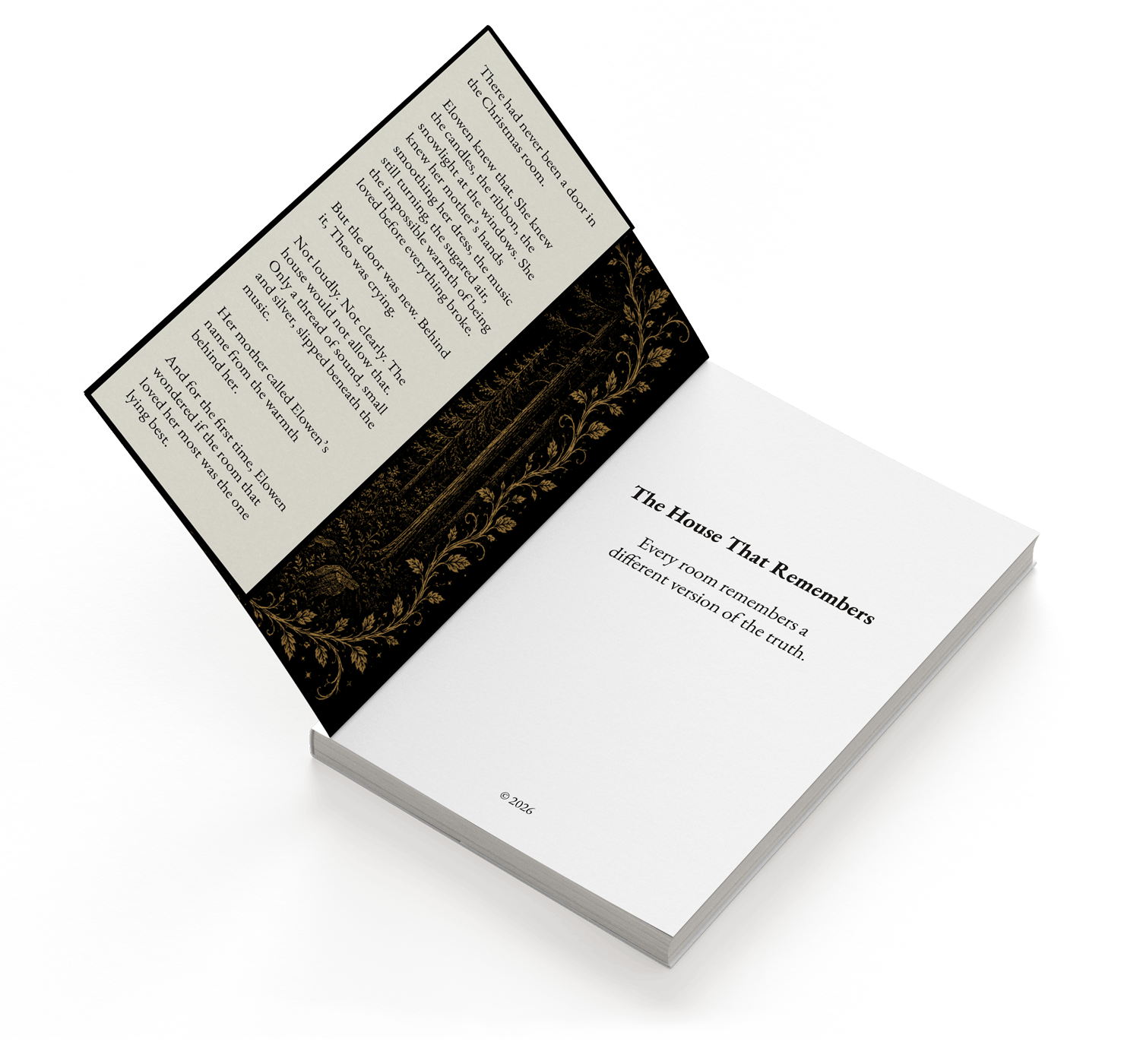
After all the false starts, finally—your book.
Not more fragments. Not another pile of promising parts. A story taking its true shape. A book whose premise, plot, and emotional truth lock into one whole.
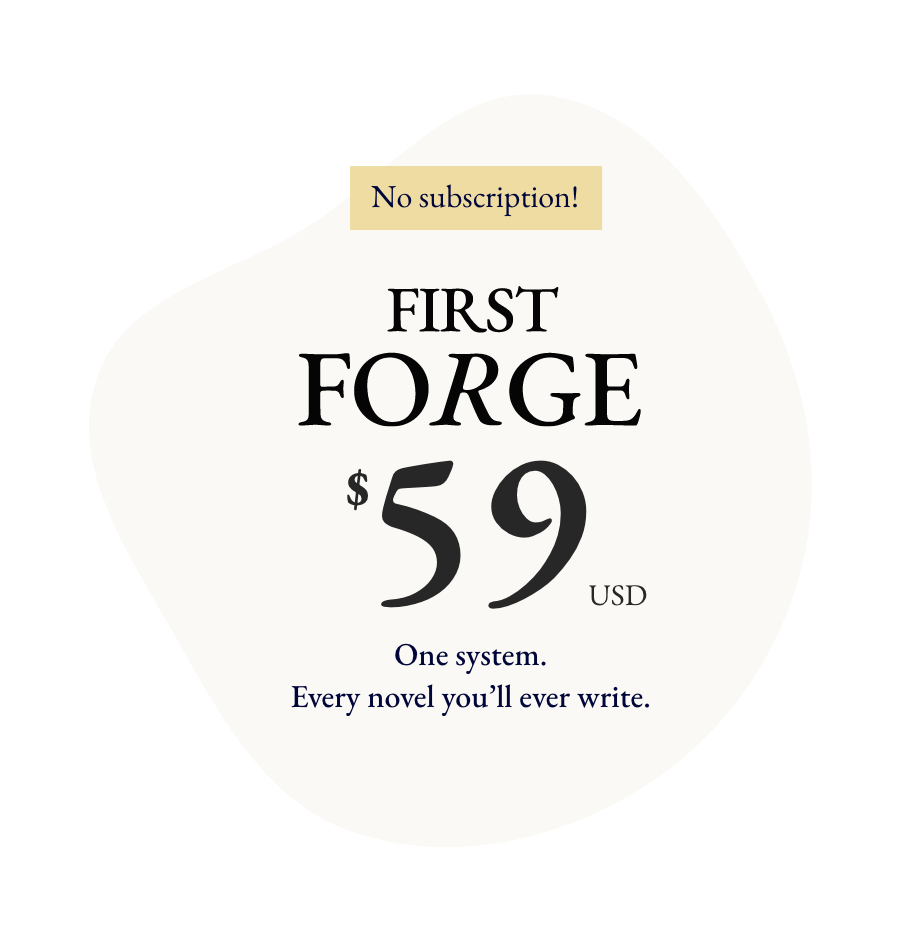
After all the false starts, finally—your book.
Not more fragments. Not another pile of promising parts. A story taking its true shape. A book whose premise, plot, and emotional truth lock into one whole.
About the creator
My brother tried AI on his novel. What came back was ideas, characters, themes — everything except a story. That's what I built First Forge to fix.
I'm Sarah Berti, editor, author, and founder of Bright Leaf Literary.
For years I kept seeing the same pattern: writers came in with real imagination, soul, fire, and beautiful material — but no clear way to architect that material into a story that was aligned with itself.
They did not lack creativity. They lacked architecture.
A novel is an ecosystem. Specific elements have to carry specific weight in the right order, or the whole thing starts leaning mysteriously — like a charming half-built house that collapses the moment someone asks, "So what's it about, exactly?"
Normally, helping a writer find that structure takes time, money, editing, coaching, and sometimes one or seven abandoned drafts everyone politely agrees was "part of the process." Most writers never get that level of craft guidance.
Then my brother asked me to help him use AI on his book. He had already tried on his own, and the results were enthusiastic. Ideas multiplied. Characters multiplied. Themes multiplied. What did not emerge was a story with heart, soul, and inevitability.
That was the turning point. AI didn't need to replace the writer. It needed editorial thinking about how to make stories coherent.
So I built Story Imaginarium to bring that missing layer in — not to write the book for you, but to help AI function more like an editor, coach, and structural mirror: asking the right questions in the right order so the architecture of the story can come into focus and craft intelligence can be applied to every layer.
At heart, this is about one thing: making sure the book that's in you actually gets out — whole, and true to what you meant it to be.
First Forge includes The Creative Sovereignty Codex — part of the free Sovereign with AI series I created because I believe the conversation about how writers use AI matters as much as the tools themselves.

About the creator
My brother tried AI on his novel. What came back was ideas, characters, themes — everything except a story. That's what I built First Forge to fix.
I'm Sarah Berti, editor, author, and founder of Bright Leaf Literary.
For years I kept seeing the same pattern: writers came in with real imagination, soul, fire, and beautiful material — but no clear way to shape that material into a story that was aligned with itself.
They did not lack creativity. They lacked architecture.
A novel is an ecosystem. Specific elements have to carry specific weight in the right order, or the whole thing starts leaning mysteriously — like a charming half-built house that collapses the moment someone asks, "So what's it about, exactly?"
Normally, helping a writer find that structure takes time, money, editing, coaching, and sometimes one or seven abandoned drafts everyone politely agrees was "part of the process." Most writers never get that level of help.
Then my brother asked me to help him use AI on his book. He had already tried on his own, and the results were enthusiastic. Ideas multiplied. Characters multiplied. Themes multiplied. What did not emerge was a story with heart, soul, and inevitability.
That was the turning point. AI didn't need to replace the writer. It needed editorial thinking.
So I built Story Imaginarium to bring that missing layer in — not to write the book for you, but to help AI function more like an editor, coach, and structural mirror: asking the right questions in the right order so the architecture of the story can come into focus.
At heart, this is about one thing: making sure the book that's in you actually gets out — whole, and true to what you meant it to be.
First Forge includes The Creative Sovereignty Codex — part of the free Sovereign with AI series I created because I believe the conversation about how writers use AI matters as much as the tools themselves.